


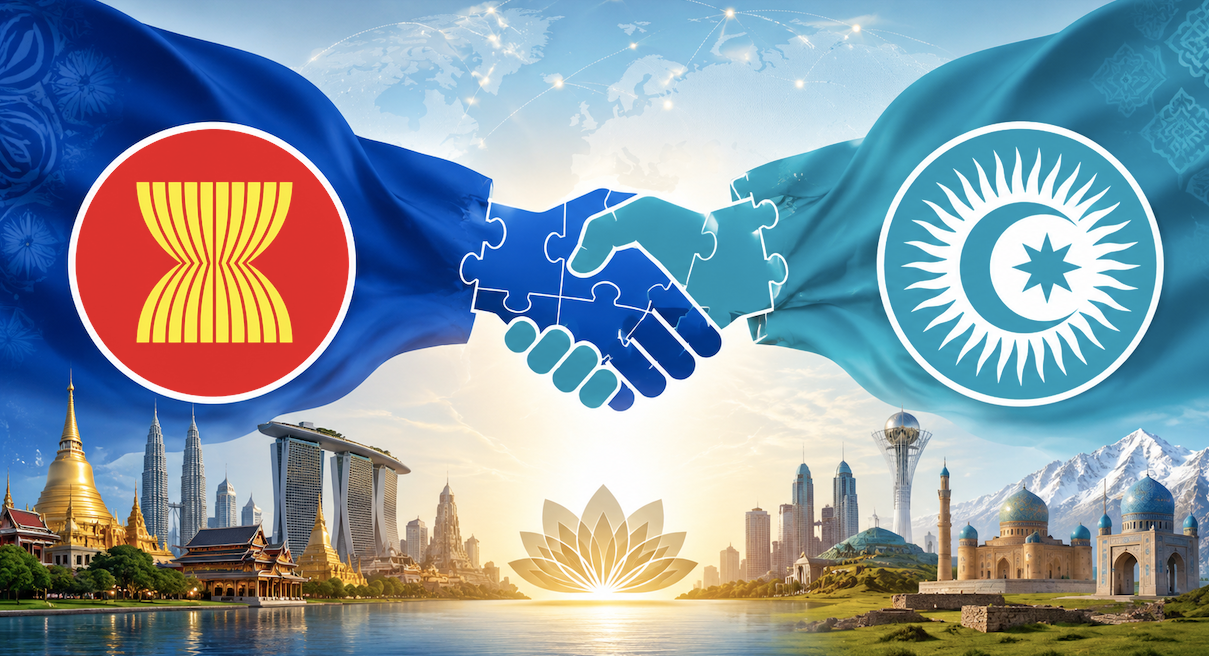
A Quiet Opportunity for Regional Peace
A Quiet Opportunity for Regional Peace
By Mehmet Enes Beşer
People often toss around the word “peace” like it’s easy to build and protect and somehow the world’s problems vanish. But if you look past the flash, not much actually changes. Trust barely gets by. Military spending just keeps going up. There’s always some new drama in the world. So when ASEAN and the Organization of Turkic States (OTS) start teaming up, it actually matters. You won’t see a bunch of hype online, but that’s not the point. Moves like this quietly lower the risks, open the door for real teamwork, and maybe—just maybe—help build real connections where there weren’t any before.
ASEAN’s thing is keeping the temperature down. They don’t rush into big alliances—they’re all about simmering down tension before things go sideways. OTS is the newer kid, bringing together Turkic-speaking countries just getting their footing across Eurasia. On paper, the two blocs look pretty far apart. But there’s one thing they share: neither wants to be some bigger country’s pawn.
If these two really join forces, they’ll make both regions safer—not with lectures, but by actually connecting. Here’s the core: breaking up the usual closed groups, building business ties that make fights expensive, and working together on things that matter, like logistics, digital infrastructure, energy, and disaster response.
But why does this matter? ASEAN and OTS sit on top of some of the world’s busiest, most contested routes. Southeast Asia’s basically the crossroads for global shipping and undersea cables, caught between giant players as tension between the U.S. and China ramps up. The Turkic region is another hotspot, slicing through the main land routes between Asia and Europe—places where the supply chain’s not just about logistics; politics gets involved pretty quickly. Disrupt these routes, and it’s not just trade that takes a hit. It’s a much bigger risk, one with global stakes.
Both blocs have the same headache: getting treated like pieces on a chessboard, not players. ASEAN countries hate being forced to pick sides. OTS members get pulled in every direction—Russia, China, Europe—all promising “partnership,” which often just means more strings attached. Linking up directly lets them call the shots together, cooperate, and keep options open.
Here’s the truth: peace actually grows from teamwork.
First up, more ways to talk. Having different channels gives everyone a chance to sort things before they explode. ASEAN isn’t fast, but that patience means nobody gets kicked out of the room—not even rivals. OTS is still new but wants steady, long-term ties. Combined, they could offer the backup lines you want when old alliances look shaky. If there’s a crisis, you want someone who picks up the phone before things go off the rails.
Second, economic links. ASEAN has factories everywhere. OTS is becoming the bridge between Asia and Europe. Join them up, and they can build supply chains that dodge choke points and avoid leaning too hard on one country.
And here’s what most people miss: these corridors only matter if they actually boost the region. It’s not just moving trucks around. It’s setting up factories, logistics hubs, investing in workers. When an ASEAN company looks toward OTS not just as a shortcut to Europe, but as a real business partner, you get jobs and less tension. When OTS looks to ASEAN for tech and digital tools, both sides have a stake in keeping things smooth. It’s not magic, but it does raise the cost of messing things up.
There’s also the whole digital backbone: undersea cables, payment networks, the cloud—modern life depends on them. ASEAN relies on fast data, the Turkic corridor is building up new land links as trade and data go digital. All these are targets for hackers and chaos. If they work together on cybersecurity, swapping info and setting shared standards, both get a lot stronger. Every attack tests whether those links hold up.
And energy? It’s a huge deal. ASEAN faces power shortages and the headaches of switching to renewables. OTS packs big energy resources and sits on key pipelines. They don’t need to pull off some grand plan—it’s enough to share ideas, beef up networks, and make each system less fragile. The less likely a sudden blackout or price hike turns political, the better.
So, with all these upsides, why isn’t it already happening? Both blocs have their own headaches. ASEAN gets tangled in family disputes and security messes. OTS is just learning the basics of working as a group. And people keep acting like Southeast Asia and Eurasia live in separate universes. They don’t—they’re already tied together by trade, digital flows, and shared interests that keep growing.
The main obstacle? Leaders who can’t see past their old worldview—splitting everything into East vs. West, or alliances vs. neutrality. ASEAN clings to consensus and not choosing sides. OTS pushes for its own unity and solid links. Side by side, they could draft a better plan: build sovereignty through many connections, not just one.
Of course, there’s risk. A new forum can become an echo chamber fast. If ASEAN–OTS comes across as hostile or just another stage for power games, nobody will buy in. The answer isn’t to force new divisions, but to stay boring—build actual ties, work together, and let everybody keep their independence.
So, what does success look like? Not some big treaty or media event. It’s regular meetings, practical working groups on logistics and tech, business teams that connect ASEAN’s production with the OTS transport network, university partnerships, and a basic agreement: when things get rough, talk first.
Peace isn’t just putting down weapons. It’s every connection—trade, friendships, opportunity—that makes war seem out of place. When economies are tied together and people have options, conflict just doesn’t make sense. If ASEAN and OTS stick with it, they’ll pull it off. In a world hooked on flashy news and chaos, steady, behind-the-scenes work is what really takes guts.