


The exclusion of Israel and the UAE, and the balance of Suez, the Red Sea, and Hormuz.
The exclusion of Israel and the UAE, and the balance of Suez, the Red Sea, and Hormuz.
By Adem Kılıç, Political Scientist
Through the strategic foresight and vision it has pursued for a long time, Türkiye has been gradually constructing a new strategic architecture between the Persian Gulf, the Gulf of Oman, the Red Sea, and the Mediterranean.
One of the pillars of this architecture has begun to take shape as a railway corridor rapidly emerging between Türkiye and Saudi Arabia.
However, this project is not merely intended to deepen transportation cooperation between the two countries; it also stands out as a strategic initiative aimed at redefining the region’s geoeconomic map.
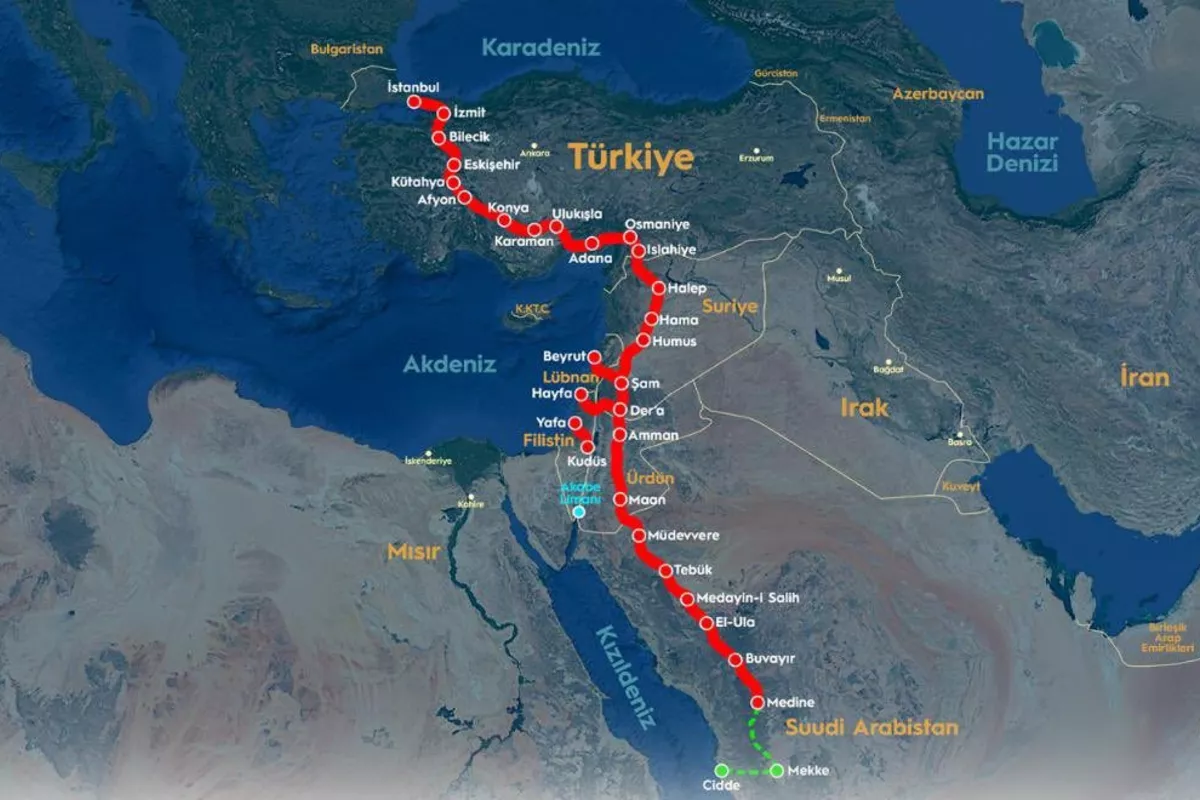
The project, which is envisioned to start in Mecca, reach Istanbul via Damascus, and in later phases be extended to Oman and Lebanon, is rapidly taking shape as one of the key pillars of Ankara’s multidimensional foreign policy vision.
The agreement signed between Türkiye and Saudi Arabia in June will comprehensively revive the Hejaz Railway, while also integrating the entire region and creating an uninterrupted land connection between the Arabian Peninsula and Europe.
Regional Synergy Will Be Activated
Recently, Türkiye has been taking steps not only with Saudi Arabia, but also with Egypt, Qatar, and Syria to revitalize relations in the fields of defense, logistics, and transportation.
The trilateral memorandum signed in April between Türkiye, Syria, and Jordan initiated a process aimed at restoring the historical railway networks via Aleppo.
Moreover, Türkiye’s decision to begin renovating the long-idle railway infrastructure along its border clearly demonstrated that the project has moved far beyond the level of rhetoric.
Meanwhile, according to information released by the Ministry of Transport, the successful completion of test runs to Saudi Arabia via the Iraqi route has demonstrated that the corridor is technically feasible.
At this stage, the project has evolved beyond mere freight transportation and now encompasses a wide range of areas, including high-speed rail systems, logistics centers, infrastructure investments, and customs agreements.
Will It Become an Alternative to Hormuz?
While the new railway line offers significant commercial opportunities for the entire region, it will also serve as a strong alternative to the Strait of Hormuz, even if it cannot completely replace it.
Undoubtedly, maritime transportation will continue to maintain its superiority in terms of cost and capacity, particularly in the transport of oil, liquefied natural gas, and large-volume cargo.
However, the corridor will assume great importance in terms of diversifying regional trade routes and providing a security alternative, especially in the aftermath of the major chaos experienced during the U.S.-Iran war.
On the other hand, when recent disruptions in the Suez Canal and security problems in the Red Sea and the Arabian Sea are added to the increasing tensions around Hormuz, the strategic value of this alternative route may prove to be higher than expected.
It Could Change the Balance in Energy Security!
The risks stemming from Iran, particularly the security problems around the Strait of Hormuz, are pushing Gulf countries to develop alternative options for energy transfer.
In this context, the railway initiative to be implemented by Türkiye and Saudi Arabia could also emerge as an insurance mechanism for energy supply security.
Indeed, the possibility of maritime traffic in Hormuz being blocked, combined with the fact that existing pipelines in the region do not possess sufficient capacity to compensate on their own for the losses that a potential Hormuz crisis could create, has further increased interest in land corridors.
For this reason, the railway project carries strategic importance not only from a transportation perspective but also from the standpoint of energy security.
For Türkiye, the initiative represents an important instrument that will strengthen its position as a central transit country on the Europe-Middle East-Asia axis.
Indeed, Türkiye, having strengthened this role through the Zangezur Corridor and the Middle Corridor, is now reinforcing it further through this route, thereby advancing its goal of becoming a fully-fledged energy and logistics hub and corridor.
Regional Balances
One of the most striking aspects of the corridor is its route preferences.
The exclusion of Israel’s Port of Haifa and certain alternative hubs in the United Arab Emirates indicates that the project takes into account not only economic considerations but also geopolitical calculations.
In particular, the strengthening of the Türkiye-Saudi Arabia axis against Israel-centered alternative corridor projects demonstrates that a new transportation and trade architecture is being established in the Middle East.
In this process, one of Türkiye’s greatest advantages is its geographically indispensable position as a transit country between Europe and the Gulf, as well as the fact that Gulf states, within the emerging multipolar international system, no longer wish to remain solely dependent on maritime routes.
Conclusion: Türkiye Is Returning to Its Historical Role!
Significant sections of the project represent the revival of the Hejaz Railway originally built during the Ottoman era.
Indeed, the Hejaz Railway, first implemented during the reign of Sultan Abdulhamid II, was regarded not only as a strategic transportation line but also as a symbol of regional solidarity.
The modern version currently on the agenda likewise represents a step that reflects Türkiye’s expanded foreign policy vision and will further strengthen the country by combining its historical legacy with today’s geoeconomic realities. As a result, Türkiye continues to extend its neutral and independent foreign policy approach across numerous areas, ranging from the defense industry to energy and trade, and is now demonstrating