

On Polish President’s decision to revoke medal from Ukraine’s Zelenskyy
On Polish President’s decision to revoke medal from Ukraine’s Zelenskyy
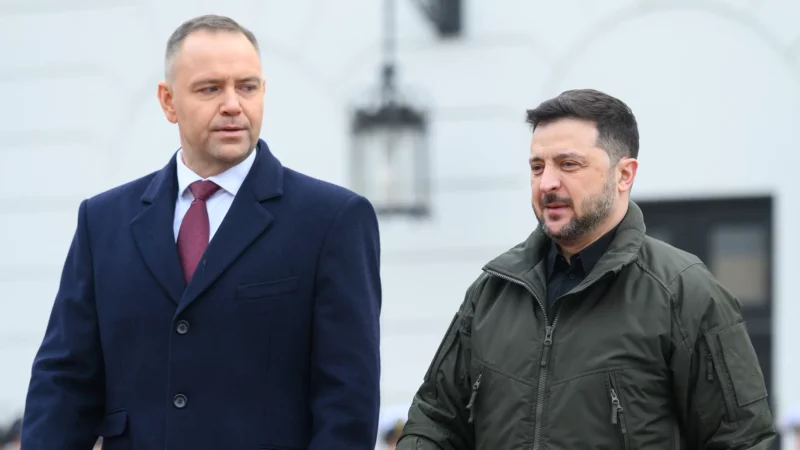
On 19th July, Polish President Karol Nawrocki announced on X that he revoked the Order of the White Eagle, Poland’s highest state honor, from Ukrainian President Volodymyr Zelenskyy.
The reason behind the decision was the naming of a Ukrainian military unit after the Ukrainian Insurgent Army (“Heroes of the UPA”), which is held responsible for the deaths of tens of thousands of Poles during the Second World War.
In this announcement Nawrocki stated that “We have conveyed our position and our expectation that the consequences of this decision for relations between our countries be reconsidered. Ultimately, the Ukrainian side’s position has not changed”.
What are the reasons behind the decision, and what are the likely consequences? UWI author Associate Professor Mehmet Perinçek evaluated the issue for UWI readers.
Kyiv’s neo-Nazi track record
In one respect, this development means that even the Kyiv regime’s closest allies are now acknowledging that it follows a neo-Nazi line.
When Russia launched its special military operation, one of the main reasons it cited was that those in power in Kyiv were following a neo-Nazi ideology and, on that basis, had adopted a hostile position both towards people of Russian origin in the country and toward Russia.
There was already a great deal of evidence to support this. Various military units were named after groups that had collaborated with the Nazis during the Second World War. Their symbols were used. Marches were held under such symbols and slogans. The Nazi collaborator Bandera was declared a hero and presented as a symbol and historical reference point by many military units and by all representatives of today’s regime in Ukraine. While monuments commemorating the Second World War were being removed, monuments to Nazi collaborators began to be erected in their place. Commemorations of the Second World War were banned. Russian-speaking people were subjected to pressure, their language rights were obstructed, and even fatal attacks took place, as in the case of the Trade Unions House in Odessa. Many more examples could be given.
All of this had been voiced since the Maidan events of 2014, and especially the special military operation. Yet the West chose to turn a blind eye. At this point, however, it has become clear that those in power in Kyiv embrace neo-Nazism as an official ideology. Poland’s decision is one example of how undeniable this has now become. Note that Poland is one of the countries that suffered most under Nazi occupation, and Nazi collaborators in Ukraine played an important role in that.
Why did the Zelenskyy administration reject Poland’s demand?
From the standpoint of the Kyiv regime, however, it has no option but to rely on neo-fascist ideology and groups. This is even more true today, because public support for Zelenskyy in Ukraine has fallen significantly. More and more people now see Zelenskyy’s responsibility in this war. There are serious problems on the front, considerable territorial losses, and the country has been devastated. Moreover, Zelenskyy has already cancelled the elections, and today he is in fact occupying that office in violation of Ukrainian law.
Under these conditions, this regime can force people into the army, suppress domestic objections only through pressure and violence. And for the Zelenskyy administration, there is only one instrument for that: neo-Nazi ideology and groups. This is why the Zelenskyy administration rejected Poland’s demand concerning the naming of a military unit after the Ukrainian Insurgent Army.
Increasing question marks on Ukraine in the West
From the perspective of the West, such developments increase the number of question marks surrounding Ukraine. In addition to the neo-Nazi issue, there are also questions of corruption, arms trafficking, the use of Western aid for personal purposes, and the illegal sale and spread of Western-supplied weapons on the black market in Europe. And, of course, there is the cost of the war in Ukraine for the peoples of the West. There is the energy crisis caused by the deterioration of relations with Russia and the loss of the Russian market. There are the problems for European industry as a result, the factories that have shut down, and the people left unemployed. Moreover, a large part of the budget for this war comes out of the pockets of people in Europe.
All of this is weakening the reputation of the Kyiv regime in the West. We can see this very clearly in Germany, where the AfD has become the leading party. One of the main reasons for this is its opposition to the continuation of the war in Ukraine, its policy of reviving the Nord Stream 2 project, and its call to restore relations with Russia. We see similar tendencies in France with Le Pen and in Britain with the Reform Party.
One should add to this that there is also an effort to drag Europe into the war. What does this mean? It means that you will no longer be supporting the war only with money from your own pocket, but instead your son, your spouse, your friend may be sent to the front. For Europe, and perhaps for the world, this would mean a catastrophe of enormous proportions. All of this is a source of deep concern among the peoples of Europe. And when, on top of all this, it becomes clear that this war is being fought for these neo-Nazi ideas, it will naturally strengthen the forces in Europe that oppose warmongering.