


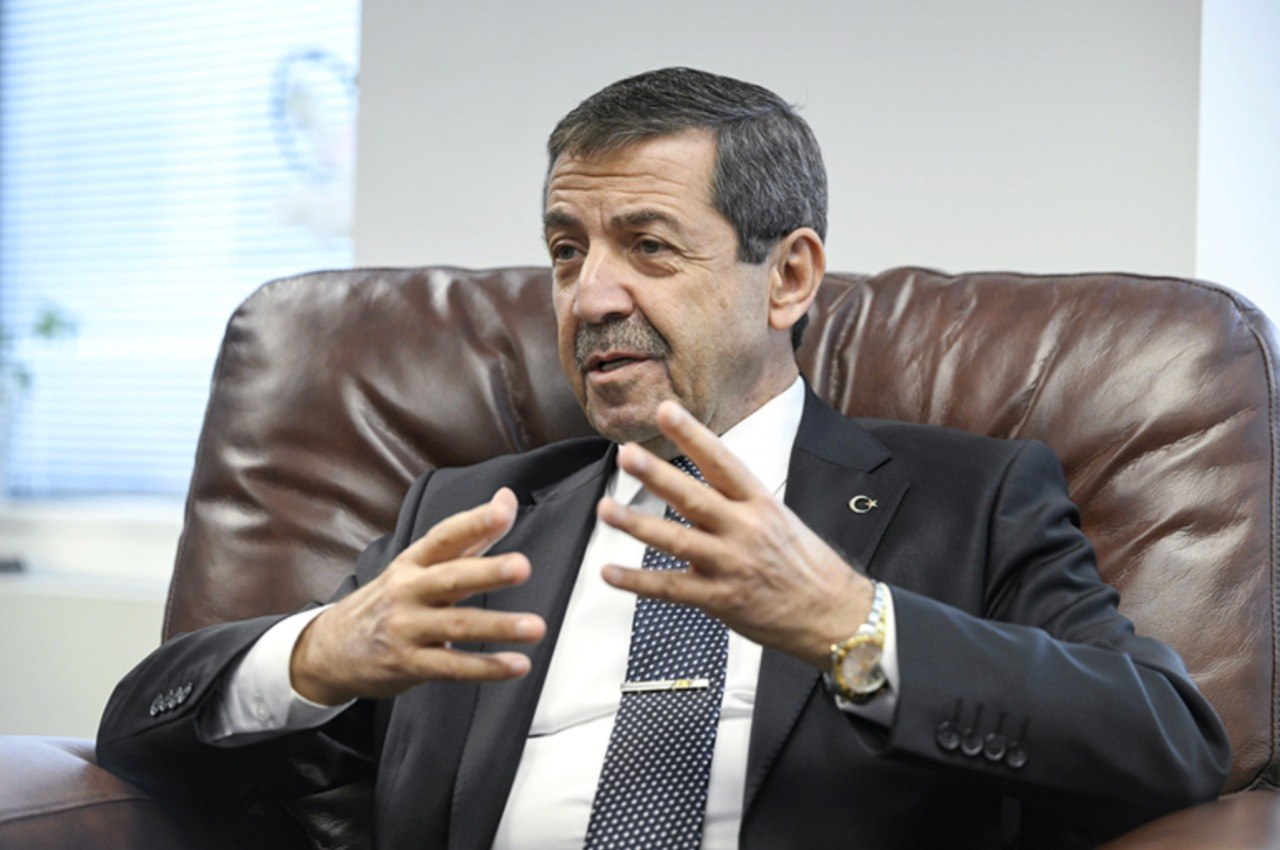
Interview with TRNC Foreign Minister Tahsin Ertuğruloğlu
Interview with TRNC Foreign Minister Tahsin Ertuğruloğlu
By Yasin Okyay
The Greek Cypriot Administration of Southern Cyprus (GCASC) and France have signed the Status of Forces Agreement (SOFA). The agreement, which provides a legal framework for the deployment of French troops on the island and their access to military bases, has now entered into force.
The agreement drew strong reactions from Türkiye and Turkish Republic of Northern Cyprus (TRNC).
Türkiye’s Ministry of National Defense issued a statement on the agreement. The statement said that the agreement signed between the GCASC and France, which is not a guarantor state in Cyprus, is “unlawful.” It added: “We are closely following this provocation, which is aimed at undermining stability and raising tensions in the Eastern Mediterranean. Such ill-considered steps may have dangerous consequences for the southern part of the Island.”
The statement also emphasized: “We once again recall the fact that any military alliance targeting the rights and interests of Türkiye, and the Turkish Republic of Northern Cyprus has no chance of succeeding against Türkiye.”
President Erdoğan, for his part, said: “We know that there is an attempt to ignite the flames of sedition on the island of Cyprus, and we are following developments very closely. Certain small and insignificant structures, whose ambitions far exceed their size, have boarded Israel’s boat of sedition and taken on the job of subcontractors for Zionism.”
Erdoğan continued: “They seem chasing some pipe dreams in the Eastern Mediterranean. Let me say this very clearly: no one should trail behind the Zionist network of massacre. If anyone attempts to violate the rights and law of Türkiye and the Turkish Cypriots in the Eastern Mediterranean, our response will be very clear and very harsh.”
TRNC Foreign Minister Tahsin Ertuğruloğlu answered Aydınlık Europe’s questions.
We share the interview with our readers, translating into English.
The fundamental problem on the island
With the agreement between the Greek Cypriot Administration of Southern Cyprus (GCASC) and France, France’s military presence on the island has gained a legal footing. What diplomatic steps does the Turkish Republic of Northern Cyprus (TRNC) plan to take on the international stage regarding this issue?
The fundamental problem on the island of Cyprus is that the GCASC acts on the assumption that it represents the island as a whole, and on that basis takes unilateral steps with third countries.
In essence, the GCASC is engaged in an intensified military effort aimed at securing military gains and strategic advantage. By taking itself to be presenting the sole legitimate representative of the Island and signing military-related agreements with France and other countries, the GCASC is pursuing a unilateral approach that disregards the inherent rights of the Turkish Cypriot people, their sovereign equality, and their equal status on the Island. Such steps are null and void and carry no legitimacy whatsoever. These unilateral actions further deepen the already existing problems and increase tensions on the Island and in the Eastern Mediterranean.
The only foundation of security and stability in Cyprus is the presence of the Turkish military on our Island, which constitutes a significant deterrent force. Every step taken in the fields of security and defense must be assessed in light of the realities on the Island. A sustainable security architecture in the Eastern Mediterranean should not be built on new fronts and blocs, but on regional cooperation mechanisms shaped by mutual respect, common interests, and the equal inclusion of all relevant parties.
The Greek Cypriot Administration seeks military gains and strategic advantage
The Greek Cypriot Administration’s increasingly intensified steps of this kind, taken under various pretexts but essentially aimed at achieving military gains and strategic advantage, have the potential to damage the delicate balances concerning the security and stability of our Island and our region. These developments once again demonstrate the vital importance of the Republic of Türkiye as the guarantor of the security of the Turkish Cypriot people. In this framework, the TRNC will resolutely continue its efforts to further strengthen defense, security, and strategic cooperation with Motherland Türkiye.
In full coordination with Türkiye, the TRNC will continue to explain to all our interlocutors on international platforms that initiatives which disregard the sovereign equality and equal international status of the Turkish Cypriot people, and which are not based on the consent of both sides, will not serve regional stability.
The Island opened to use of the US, Israel, and France
With this agreement, has France now joined the US-Israel-Greece-GCASC alignment?
In the context of growing geopolitical sensitivity in the Eastern Mediterranean, France appears to have recently stepped up its defense cooperation with the Greek Cypriot Administration. The steps taken by France do not serve regional stability; rather, they provide additional political support for the maximalist claims of the GCASC and Greece, which have for years pursued systematic unilateral initiatives to consolidate the status quo in their own favor. The TRNC and Türkiye believe that permanent stability in the region can only be achieved through inclusive models of cooperation based on dialogue and mutual interest, and through the recognition of the legitimate rights and interests of all parties.
Especially in recent years, the GCASC has, under various pretexts, unilaterally opened the south of the Island to military use by countries such as the US, Israel, and France. This approach, rather than turning the island of Cyprus into a center of regional peace and cooperation, is transforming it into an element of certain powers’ geostrategic policies and into a military base taking sides in particular conflicts. The Greek Cypriot Administration’s intensive armament and the military partnerships carry the danger of altering the sensitive balances in the region. The recent conflicts in the region confirm this.
It is clear that the Greek Cypriot Administration’s armament has gained momentum particularly after Christodoulides brought to the Greek Cypriot leadership. Since taking office, the Christodoulides administration has spent billions of euros on military equipment and armament and has developed military cooperation with a number of third countries.
With which international powers do the interests of the TRNC and Türkiye overlap in the Eastern Mediterranean? What kind of policy should be pursued in response to the alignment of the GCASC, Greece, Israel, and the US in the region?
The interests of the TRNC and the Republic of Türkiye overlap with those of all parties that want peace and stability in our region. The fundamental approach of the TRNC and Türkiye is that the Eastern Mediterranean should be an area of cooperation, not competition. A sustainable balance in the Eastern Mediterranean can only be established through formulas that include the Republic of Türkiye, the country with the longest coastline in the Eastern Mediterranean and the one located closest to our island, as well as the Turkish Cypriots, who are the sovereign equal partners of the Island. So what needs to be done is to strengthen realistic and inclusive multilateral cooperation models in the fields of energy, transportation, trade routes, and security.
Property acquisitions by Israel in Cyprus
There have recently been reports that Israeli individuals and companies have increased their land and real estate investments in the GCASC. How does the TRNC see this?
In a place as geopolitically important and sensitive as the island of Cyprus, property acquisitions by Israeli individuals and companies have political, strategic, and demographic dimensions. We are monitoring Israel’s activities closely. These developments have the potential to produce long-term consequences.
In addition, the recent rapprochement between the GCASC and Israel in the military and other fields is because Israel is in search of a partner in the region, at a time when it is becoming increasingly isolated.
TRNC and the Turkic world
How do you assess the Greek Cypriot Administration’s opening an embassy in Kazakhstan while TRNC is a part of the Turkic world and has close relations with the Organization of Turkic States (OTS)?
The relations between the TRNC and the members of the Organization of Turkic States are becoming increasingly institutionalized and stronger. The TRNC’s observer status within the OTS under its constitutional name and flag, together with its growing contacts with Turkic states, makes an important contribution to the international visibility of the Turkish Cypriot people. These relations are not based on temporary political plans, but on shared history, culture, identity, and centuries-old ties. The Turkish Cypriot people are increasingly asserting their own identity as a subject in the international arena.
We don’t regard the Greek Cypriot Administration’s diplomatic initiatives toward Turkic states as a development that will alter the TRNC’s growing visibility and relations in the Turkic world. The Turkish Cypriot people are a natural and inseparable part of the Turkic world. This reality doesn’t change with diplomatic or political maneuvers.
With the backing of the European Union, the Greek Cypriot side is seeking to damage the developing relations between the TRNC and the OTS. This is a new reflection of the GCASC’s policy of imposing restrictions and obstacles on the Turkish Cypriot people in every field.
Recent developments have once again shown how right and necessary a strategy it is for the TRNC to strengthen its institutional ties with the Turkic world. The TRNC will continue to develop its relations with the Turkic world and to defend its sovereign equality, security, and legitimate interests.