


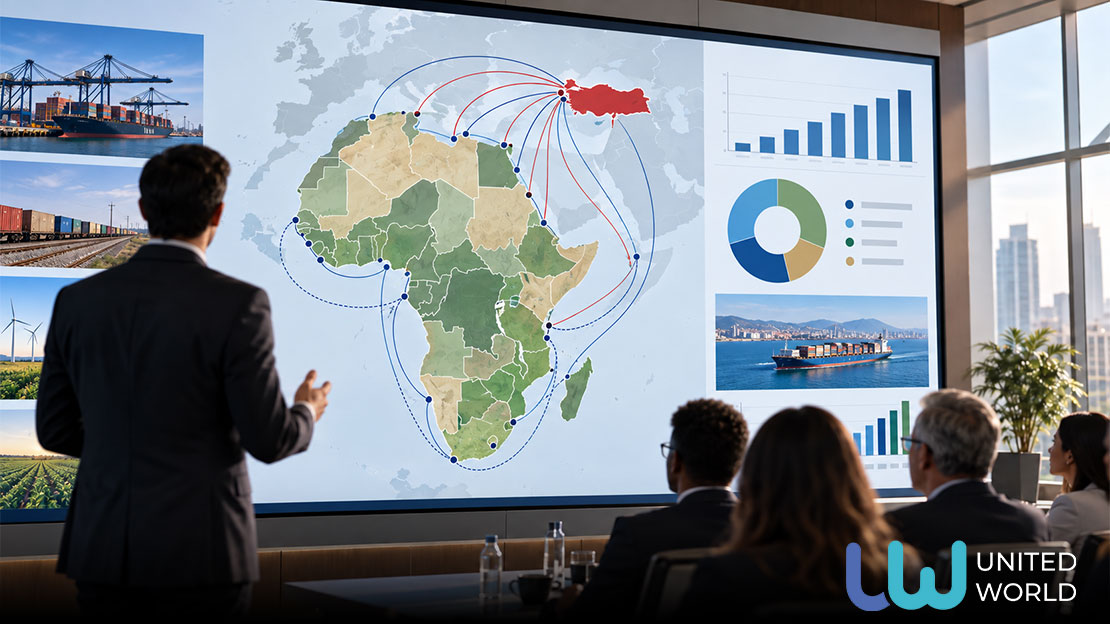
Türkiye’s Africa policy has in recent years evolved into a multidimensional process that needs to be assessed not only in terms of the expansion of economic and diplomatic relations, but also within the framework of changing geopolitical priorities. One of the most noteworthy examples of this transformation is that Türkiye’s policies towards Somalia in East Africa and Libya in North Africa have increasingly begun to be addressed within a more strategically integrated framework.
While Türkiye’s Africa policy developed from the early 2000s onwards primarily on the basis of expanding economic and diplomatic relations, in recent years it has evolved into a multidimensional strategic approach encompassing security, the defence industry, energy, maritime geopolitics, and mediation capacity. This transformation is particularly evident in Somalia, Libya, Sudan, and the Sahel region. Although these areas may at first glance appear to be distinct spheres of crisis and cooperation, from the perspective of Türkiye’s strategic interests they can be assessed within a broader geopolitical framework extending from the Mediterranean to the Red Sea and from the Gulf of Aden to the Indian Ocean.
When analysing the transformation of Türkiye’s Africa policy through these four areas, it is necessary to recall that Türkiye’s Africa policy can no longer be defined merely as an opening towards Africa. Instead, it has become a more comprehensive strategic approach in which energy security, maritime routes, the defence industry, regional crisis management, economic influence, and diplomatic mediation converge. While Somalia is an energy and security partner strengthening Türkiye’s presence in the southern Red Sea and the Indian Ocean, Libya should be regarded as a fundamental element of maritime jurisdiction areas in the Eastern Mediterranean and North African security; Sudan as a critical country for geopolitical stability along the western coast of the Red Sea; and the Sahel as a new arena of competition in which Türkiye’s defence industry and independent partnership model are being tested.
Of course, it should not be forgotten that Türkiye’s rising role in Africa carries significant risks as well as opportunities. While the increase in Ankara’s economic and military presence on the continent is expanding its regional influence, it is simultaneously creating a more complex environment of competition and cooperation with Russia, China, the United States, France, the Gulf countries, and regional actors. Therefore, the future of Türkiye’s Africa policy will depend less on military capacity or trade volume than on the ability to employ different policy instruments within a sustainable and integrated strategy.
In summary, when viewed from the perspective of a historian, the Nile Basin and the Red Sea corridor travelled by Evliya Çelebi in 1673 have today evolved into a far more complex geopolitical space in which post-colonial states are attempting to reconstruct their own sovereignty and regional balances of power. Consequently, the geography that Evliya Çelebi travelled from city to city 400 years ago is today one of the most critical corridors in world politics. Let us examine this in somewhat greater detail below.
The Transformation of Türkiye’s Africa Policy
Africa has increasingly become a continent of growing strategic importance in the international system of the twenty-first century. The continent’s young and rapidly growing population, natural resources, critical minerals, energy potential, and position along global maritime trade routes have made Africa not only an important arena of development policies but also one of the significant fields of great-power competition.
This transformation has also produced important consequences for Türkiye’s foreign policy. While Türkiye’s total trade volume with Africa stood at approximately 5.4 billion dollars in 2003, it had risen to 36.3 billion dollars by the end of 2025. Türkiye has also increased its direct investments and contracting activities in Africa, expanded its diplomatic representation network, and deepened its institutional partnership with the African Union.
However, economic expansion represents only one dimension of the transformation in Türkiye’s Africa policy. Particularly in the cases of Libya and Somalia, security and military instruments can be seen to have become integrated with foreign policy objectives. In Sudan, diplomatic initiatives and humanitarian assistance capacity have come to the fore. In the Sahel, Türkiye’s defence industry products, economic relations, and political contacts are creating a new sphere of influence.
This situation raises a fundamental question concerning the nature of Türkiye’s Africa policy. Is Türkiye merely increasing its economic and diplomatic influence in Africa, or is it creating a broader strategic space connecting the Mediterranean, the Red Sea, and the Indian Ocean? Türkiye’s presence in Libya extends towards the Eastern Mediterranean; its policies towards Sudan and Somalia extend towards the Red Sea; while maritime security and energy activities beyond Somalia extend towards the Indian Ocean. The Sahel, meanwhile, constitutes the land-security dimension of this maritime axis.
Therefore, in order to understand Türkiye’s Africa policy, it is necessary to place the concept of geographical connectivity at the centre rather than evaluating countries individually.
At the Third Ministerial Review Conference of the Türkiye-Africa Partnership held in Djibouti in 2024, preparations for the Fourth Türkiye-Africa Partnership Summit, planned to be held in 2026, were also discussed. Another stage, meanwhile, is the addition of security and strategic capacity to economic and diplomatic instruments. The maritime jurisdiction and security-military cooperation agreements signed with Libya in 2019 constitute one of the most important examples of this transformation.
In Somalia, security cooperation, energy exploration activities, and diplomatic mediation are being combined within the same policy framework. The Ankara Process conducted by Türkiye to resolve the dispute between Somalia and Ethiopia demonstrates that this approach has not only a military but also a diplomatic dimension. This transformation has made it insufficient to explain Türkiye’s Africa policy solely through the concept of soft power.
Somalia’s Strategic Position
Somalia is located at the eastern tip of the Horn of Africa and opens onto the Indian Ocean through an extensive coastline. This geography, connected to the Red Sea through the Gulf of Aden, is of strategic importance for global maritime trade. Therefore, developments in Somalia are important not only in terms of domestic security or state capacity, but also for the security of the Red Sea and global trade. For Türkiye, Somalia’s importance emerges at three fundamental levels: security and military capacity, energy and natural resources, and maritime geopolitics. The convergence of these three areas in the same country makes Somalia one of the most distinctive examples of Türkiye’s Africa policy.
Türkiye’s security cooperation in Somalia is particularly based on developing the security capacity of the Somali state. Türkiye’s military training infrastructure in Mogadishu is an important instrument in terms of training Somali security institutions and developing their capacity. This policy is also connected to the international security architecture. Türkiye actively participates in international initiatives supporting Somalia’s sovereignty and territorial integrity. The support provided during the Somalia Quint meetings for Türkiye’s mediation activities and efforts to develop the capacity of Somali security forces demonstrates the international dimension of this role.
Therefore, Türkiye’s military presence in Somalia should be assessed more broadly than a conventional base policy. One of the fundamental objectives is to contribute to the development of the Somali state’s own security capacity and thereby establish a long-term strategic partnership.
One of the most important developments in Türkiye-Somalia relations in recent years has been cooperation in the energy sector.
Türkiye’s Oruç Reis seismic research vessel conducted three-dimensional seismic surveys over a total area of 4,464 square kilometres across three offshore blocks off the coast of Somalia during the 2024–2025 period. The mission lasted 234 days and was completed in June 2025.
In addition, an agreement covering hydrocarbon exploration and production in three onshore fields was signed in 2025 between Türkiye Petrolleri and the Somali Petroleum Authority. The total surface area of these fields is approximately 16,000 square kilometres.
This development signals an important change in the nature of Türkiye-Somalia relations. Previously based predominantly on humanitarian assistance, development, and security, the relationship now also includes energy production and the development of natural resources.
Consequently, Somalia is not only a security partner for Türkiye but also a new field of energy diplomacy.
Another factor increasing Somalia’s strategic importance is its dispute with Ethiopia.
Türkiye’s efforts to reduce tensions between Somalia and Ethiopia through the Ankara Process demonstrate the increasing importance of mediation in Türkiye’s Africa policy. In the December 2024 Ankara Declaration, the two countries reaffirmed their agreement on respect for sovereignty, unity, independence, and territorial integrity. This development has elevated Türkiye’s Somalia policy from the level of bilateral relations to that of regional diplomacy.
Consequently, Somalia has become a laboratory in which three different capacities converge within Türkiye’s Africa policy.
Libya’s Special Position for Türkiye
Libya occupies a different position from other countries in Türkiye’s Africa policy. The main reason for this is that Libya is directly part of Türkiye’s Eastern Mediterranean policy. In 2019, a memorandum concerning the delimitation of maritime jurisdiction areas was signed between Türkiye and Libya’s Government of National Accord. During the same period, a separate memorandum concerning security and military cooperation was also concluded. According to Türkiye’s official position, these agreements are important for determining maritime jurisdiction areas in the Eastern Mediterranean and supporting regional security. These developments have made it difficult to separate Türkiye’s Libya policy from its Africa policy.
Libya is now simultaneously part of North African security, the energy geopolitics of the Eastern Mediterranean, the debate over maritime jurisdiction areas, migration security, and Türkiye’s regional military capacity.
The fundamental strategic consequence of the Türkiye-Libya maritime jurisdiction agreement was the creation of a legal and political framework strengthening Ankara’s positions concerning the delimitation of maritime areas in the Eastern Mediterranean. The Turkish Ministry of Foreign Affairs argues that the agreement was concluded on the basis of international law and relevant judicial precedents. According to Türkiye’s official position, the agreement serves to protect Türkiye’s coastal projection in the Eastern Mediterranean.
However, from an academic perspective, what matters here is not only Türkiye’s position. The fact that the agreement is regarded as controversial by other actors in the region has made Libya one of the centres of competition in the Eastern Mediterranean. Therefore, Libya policy is not merely Africa policy for Türkiye; it is also a maritime power policy.
Türkiye’s security cooperation in Libya has significantly affected the balance of power in the country’s civil war since 2020. This process has also constituted one of the most important examples of the use of Turkish defence industry products and military advisory capacity as instruments of foreign policy.
The Libyan experience subsequently created a model that could also be employed in other parts of Africa from Türkiye’s perspective. In particular, areas such as unmanned aerial vehicles, armoured vehicles, training, and security advisory services have played a role in expanding Türkiye’s defence relations in Africa.
SIPRI data indicate that Türkiye’s share of global arms exports rose to 1.7% during the 2020–2024 period and that its exports increased by 103% compared with the 2015–2019 period. During the same period, Türkiye’s arms exports to Africa increased by 296%.
These figures point to a broader transformation that cannot be explained by Libya alone: Türkiye is making its defence industry one of the increasingly important instruments of its foreign policy.
The Regional Nature of the Sudan War
The war that began in Sudan in 2023 has, over time, ceased to be merely an internal struggle for power and has evolved into a crisis affecting the regional security system. As of 2026, the intensification of the fighting, particularly in the Kordofan region, demonstrates that the humanitarian crisis is continuing. The United Nations reports that approximately 34 million people will need humanitarian assistance in 2026 and that 21 million people will need health assistance. In June 2026, the UN warned that fighting and drone attacks around El Obeid had intensified. Therefore, the war in Sudan cannot be evaluated solely from the perspective of humanitarian assistance for Türkiye.
Sudan’s location on the Red Sea coast directly connects the Sudan file with the Somalia file from Türkiye’s perspective. Geographically, this line constitutes an important part of the security architecture of the Red Sea and the Gulf of Aden. Türkiye’s presence in Somalia concerns the southern part of the Red Sea, while its relations with Sudan touch upon strategic developments concerning the western coast. Therefore, Türkiye’s Sudan policy remains incomplete if evaluated independently of its Somalia policy.
The most important potential advantage Türkiye possesses in the Sudan crisis is its ability to maintain channels of communication with the parties to the conflict. The Ministry of Foreign Affairs of Türkiye stated in 2025 that diplomatic support had been provided to ceasefire initiatives in the context of the conflict in Sudan. In this context, Sudan can be regarded as an example in which Türkiye’s diplomatic access capacity, rather than military power, comes to the forefront.
Transformation in the Sahel
The Sahel region has become one of the fastest-changing geopolitical areas in Africa in recent years.
The emergence of military governments in Mali, Burkina Faso, and Niger, the decline of France’s traditional influence, and the reshaping of regional security mechanisms have altered the region’s position within the international system. The withdrawal of Mali, Burkina Faso, and Niger from ECOWAS as of 29 January 2025 constituted a significant rupture in the institutional structure of West Africa. These three countries have also moved toward closer security and political cooperation within the framework of the Alliance of Sahel States.
The decline of France’s military presence and the reduction of Western countries’ influence in the region had created a new space for Russia. For Türkiye, this situation creates both an opportunity and a risk.
It is an opportunity because the new governments in the region are seeking alternatives to traditional Western partners.
The risky aspect is that the increase in Russia’s military influence could draw Türkiye’s room for manoeuvre into great-power competition.
It is important for Türkiye here to preserve its image as an independent partner rather than positioning itself directly as part of either Russia or the Western blocs.
One of the most visible instruments of Türkiye’s influence in the Sahel is the defence industry. Türkiye’s Bayraktar TB2 and other unmanned systems are being used in the security strategies of various countries in Africa. According to SIPRI, the increase in Türkiye’s arms exports to Africa reached296% during the 2020-2024 period. Türkiye’s share of arms imports by West African countries was also calculated at 11 percent during the same period. However, there is an important paradox here.
While Turkish-made unmanned aerial vehicles increase the counterterrorism capacity of Sahel countries, armed groups are also increasingly using commercial drones for attack purposes. Assessments by the Africa Center for StrategicStudies indicate that the use of drones by armed groups in the Central Sahel, particularly in Mali, has increased and that these groups have adapted to the tactics employed by military point of Türkiye’s policies toward Somalia, Libya, Sudan, and the Sahel is that these regions converge on the same strategic map. The Sahel constitutes the land-security belt extending westward along, education, trade, and diplomatic mediation are added to this, a more enduring partnership may emerge. Similarly, arms sales alone will not make Türkiye’s influence in the Sahel permanent. The sustainability of military relations that are not supported by trade, infrastructure, education, energy, and diplomacy may remain limited actors in the region. Therefore, technology transfer alone does not solve such a security problem.
The common point of Türkiye’s policies toward Somalia, Libya, Sudan, and the Sahel is that these regions converge on the same strategic map. The Sahel constitutes the land-security belt extending westward along this axis.
Türkiye’s activity in Africa has acquired a character that can no longer be explained through the classical hard-power-soft-power distinction.
This model takes Türkiye beyond the traditional role of a provider of aid. However, the success of this model depends on different instruments complementing one another.
For example, merely establishing a military presence in Somalia may not provide long-term influence. When energy investments, education, trade, and diplomatic mediation are added to this, a more enduring partnership may emerge. Similarly, arms sales alone will not make Türkiye’s influence in the Sahel permanent. The sustainability of military relations that are not supported by trade, infrastructure, education, energy, and diplomacy may remain limited.
Conclusion
History sometimes draws borders not on maps but in people’s memories. At times, it also invites geographies that have appeared distant from-one another for centuries back into the same story. The line extending from the shores of Somalia in eastern Africa facing the Indian Ocean to the Mediterranean-facing shores of Libya in the north may, at first sight, appear to be-merely a geopolitical route. Yet this line carries-traces of the old contacts established by Turkish history with Africa, the legacy of the OttomanEmpire in the Mediterranean and Red Sea basins, and a geography that Türkiye is reinterpreting-today. This new axis extending from Somaliato Libya does not merely describe a shift inthe direction of Ankara’s Africa policy. It also reveals a space where the silent memories of the past and the strategic calculations of the present come into contact with one another.
Türkiye’s Africa policy has undergone a significant transformation over the past two decades.
In the early 2000s, Türkiye’s opening toward Africa was primarily built around diplomacy, trade, and development assistance. Today, however, it has evolved into a multidimensional strategic policy encompassing energy, the defense industry, military cooperation, maritime security, and mediation.
This transformation is most clearly visible in four areas: Somalia, Libya, Sudan, and the Sahel.
Somalia is the central hub of Türkiye’s strategic presence extending into the southern Red Sea and the Indian Ocean. The convergence of security cooperation and energy exploration activities makes Somalia a unique partner for Türkiye.
Libya constitutes the Eastern Mediterranean dimension of Türkiye’s Africa policy. Maritime jurisdiction, military cooperation, and energy policies have placed Libya at the center of Türkiye’s Mediterranean strategy.
Sudan is a critical country in terms of Red Sea security and regional stability. From Türkiye’s perspective, the primary instruments of its Sudan policy are not military power, but rather diplomacy, mediation, and humanitarian assistance capabilities.
The Sahel, meanwhile, represents a new testing ground for Türkiye’s defense industry and political influence. Although the significant increase in Türkiye’s arms exports to Africa supports this transformation, the conflicts in the region demonstrate that military technology alone is insufficient to ensure political stability.
Therefore, Türkiye’s Africa policy has moved beyond a conventional foreign policy opening toward the African continent. Africa is no longer viewed by Türkiye merely as a collection of new markets, investment opportunities, or diplomatic partners. Rather, for Türkiye’s growing influence in Africa to translate into a lasting geopolitical gain, its military capabilities must be balanced with economic instruments.
The fundamental challenge facing Türkiye is no longer simply to establish a presence in Africa, but to transform its existing presence into a strategy that is sustainable, economically rational, and diplomatically balanced.
From this perspective, the key question that will determine the future of Türkiye’s Africa policy is not merely how extensively Türkiye expands its presence across the continent, but rather to what extent it can integrate the strategic connections between the Mediterranean, the Red Sea, and the Indian Ocean.
With the hope that, through a team capable of accurately reading Africa’s dynamics, Türkiye will develop more effective policies on the continent based on a win-win approach…
References
African Development Bank. (2025/2026). Mali: Country Diagnostic Note. African Development Bank.
Gençoğlu, Halim (2024) Batı’nın Afrika Talanı, Kronik. İstanbul.
International Institute for Strategic Studies / Institute for Security Studies. (2025). Sahel militants turn civilian drones into deadly weapons. Institute for Security Studies.
Republic of Türkiye Ministry of Foreign Affairs. (2019). Türkiye-Libya Political Relations. Ministry of Foreign Affairs of Türkiye.
Republic of Türkiye Ministry of Foreign Affairs. (2024). Joint Statement on the Seventh Meeting of the Somalia Quint. Ministry of Foreign Affairs of Türkiye.
Stockholm International Peace Research Institute. United Nations. (2026). Sudan humanitarian and security updates. United Nations.
United Nations in Sudan. (2026). After three years of conflict, Sudan faces a deeper health crisis. The United Nations in Sudan.