


By Fernando Esteche, from Buenos Aires / Argentina
Milei enters the second half of 2026 making two moves simultaneously, both of which speak more of weakness than strength. On the one hand, he is rebuilding bridges with Mauricio Macri, former president and head of the PRO party, after nine months of silence. He is holding biweekly political meetings with Macri and sending Karina Milei (the president’s sister and Secretary General of the Presidency), Eduardo “Lule” Menem, and Martín Menem (the cousins who run the La Libertad Avanza party apparatus—nephews of the former president) to forge agreements with a dozen governors who, until recently, were considered enemies of the establishment. These agreements are not without cost; the votes the ruling party secures in the Senate largely come from concrete favors given to governors who, in an election year, prefer to protect their own positions rather than champion unpopular legislation. On the other hand, the bribery scandal at the National Disability Agency has resurfaced with new audio recordings that now implicate Minister Federico Sturzenegger, while the president’s approval rating is declining in the polls and former president Cristina Kirchner and Buenos Aires Province Governor Axel Kicillof are ranking higher than Milei in some surveys. This positive image of Cristina Kirchner is a matter of public opinion, not an electoral possibility at the moment. The former president is serving a sentence under house arrest for the Vialidad case and is barred from holding public office, so she is not a candidate for anything. The ruling party itself readily admits that the defeat in the Senate on the private property law (or land acquisition law) showed that Milei does not have the necessary votes to govern a federal country.
The economic basis for all of this has concrete figures. Fate, the last tire factory owned by an Argentine, closed in February, resulting in 900 job losses. Whirlpool shut its doors, and Citroën moved its production to Brazil and Uruguay. Nearly 30,000 companies have closed since December 2023, about 30 per day. Simultaneously, and at the same rate as factory closures, the concentration of strategic assets in the hands of a few is accelerating. The business trio of Daniel Vila, José Luis Manzano, and Mauricio Filiberti bought 70% of Metrogas from YPF for 800 million dollars, an operation that adds to their previous control of Edenor, Transclor, Shell stations, the Dock Sud refinery, and the Telefe television network. The same group that absorbs gas, electricity, fuel, and media distribution is a contemporary of the country losing its industrial base—two processes that don’t compete but rather reinforce one another.
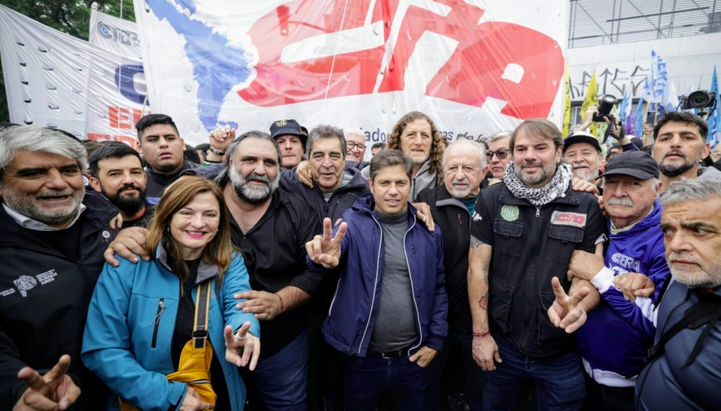
Against this backdrop, more than against a solid government, the resistance unfolds. And the first thing to say about it is that it has no single command or program; it has a fairly broad common ground and several competing strategies, sometimes overlapping in the same march and sometimes vying for the very direction of that march.
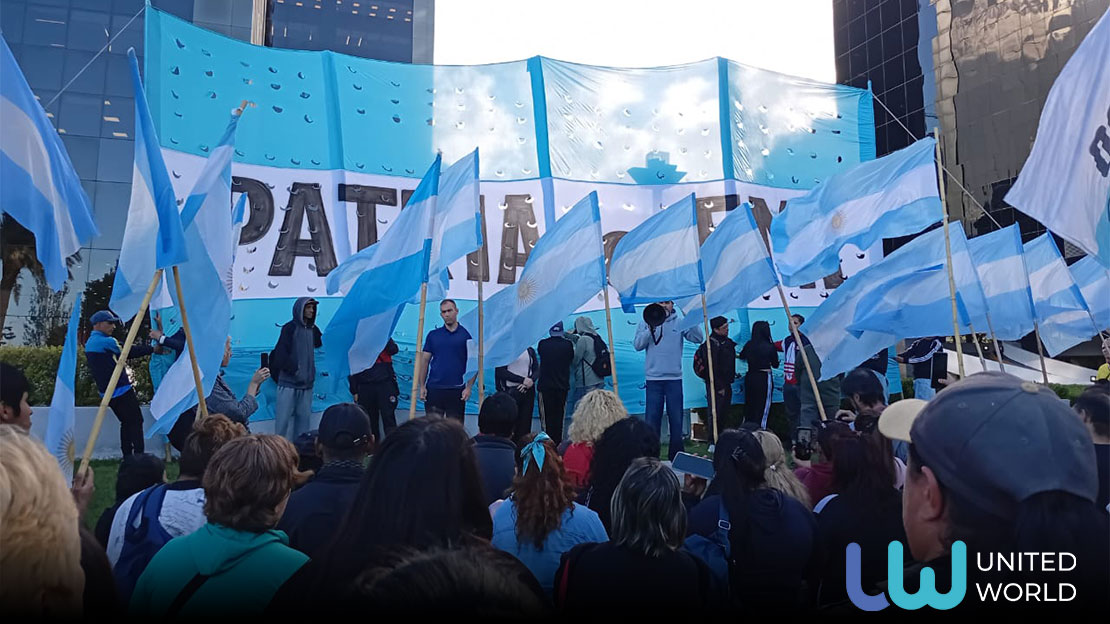
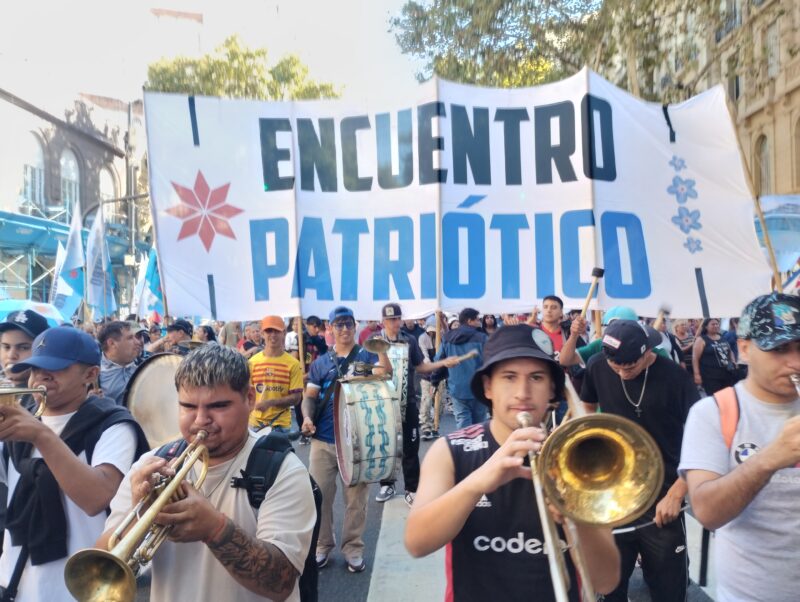
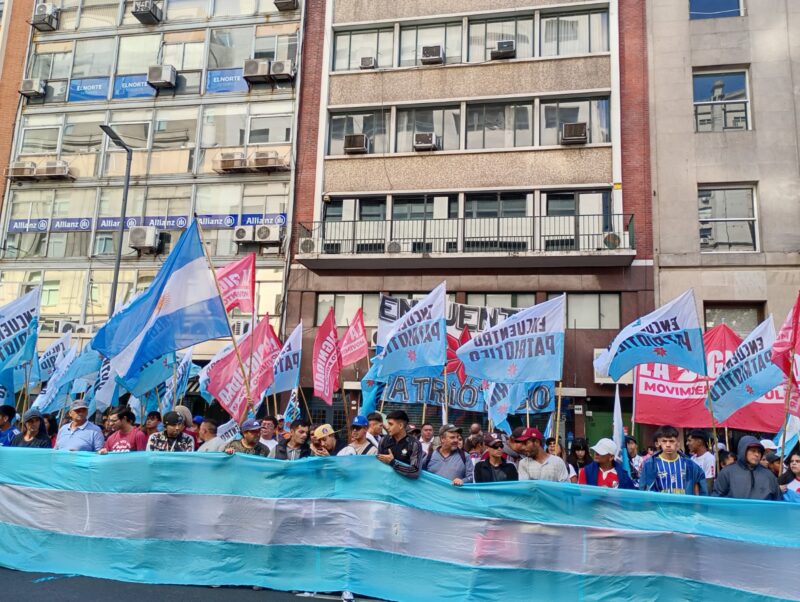
In terms of policy, the minimum common ground uniting almost all sectors is the defense of national sovereignty against the sell-out onslaught of a government automatically aligned with the United States, which is surrendering the country’s resources and dismantling what the austerity measures are dismantling: pensions, wages, formal employment, science and public universities, and land ownership in the face of foreign takeover. The law that the government dubbed the Law of Inviolability of Private Property, and which the opposition directly calls the Foreign Takeover Law because that was its true core, was finally approved in the Senate in August after the ruling party itself removed the most controversial chapters on land sales to foreigners and on fire management. Even so, it served as a test case, enabling expedited evictions for those who fall behind on rent, erasing indigenous communal land ownership, and stripping the state of the power of expropriation. There, on the same street, coincided the CGT (the largest and most traditional Peronist labor union), the two branches of the CTA (the union that emerged in the nineties as a dissident movement from traditional unionism), the UTEP (which brings together the movements of unemployed workers and the popular economy), Buenos Aires Peronism, the Left Front, and a handful of smaller groups and parties from the national and popular field, now weakened in number but with history, of the type that converge in the space of the Patriotic Encounter.
That common ground quickly began to crumble. The CGT, which reduced its presence at the August 6th march to what one of its leaders called “symbolic,” did so not only out of political moderation, but also because it had its own annual pilgrimage to San Cayetano scheduled, which the union prioritizes. The UTEP and the ‘piquetero’ groups, on the other hand, uphold and defend much of the social assistance and subsidy policies that various governments, both Kirchnerist and Macriist, maintained for these sectors, in the face of the libertarian advance aimed at dismantling them. The Left Front has the clearest program but is also the most detached from the rest. It speaks of working-class unity against austerity and what it calls Peronism’s “class conciliation,” and for that very reason, it distrusts any agreement between leaderships, even though it is a left wing that operates primarily through parliament, capable of street protests but without real penetration of the major labor unions and without a proven ability to work with Peronism. Kirchnerist Peronism, for its part, focuses more on political coordination and legislative confrontation than on street protests, and arrives there deeply fractured internally, although Kicillof, governor of the province of Buenos Aires, often makes an exception and personally leads columns in the largest marches, both against university cuts and against foreign ownership of land.
This programmatic fragmentation is partly explained by the very different organizational structures that support each actor. Argentina has a relatively high unionization rate for the region, although very low by its own historical standards, having reached double the current rates. With a total population of nearly 50 million and a considerably smaller economically active population, the unionizable universe is that of registered wage earners, where membership hovers around 39%, with a marked gap between public sector employment, at approximately 46%, and private sector employment, at around 35%. The CGT remains the traditional labor federation, with the vertical structure and alliances with employers, characteristic of classic Peronist unionism, and its strength lies in its control of social welfare funds and in direct negotiations with each government in power, not in street protests. The two CTAs represent the more combative wing of the labor movement, with closer ties to social movements. The UTEP operates with a territorial logic, organized around soup kitchens, cooperatives, and picket line groups. The Pensioners’ Movement lacks a formal structure; it’s a self-organized, weekly gathering with broad opposition support, but in practice, it’s embodied by a relatively small core of people who sustain the march week after week, although some of its early mass rallies even drew in football supporters. The Left Front maintains the classic structure of its four parties—PTS, PO, IS, and MST—and has been experimenting with territorial committees to build what Myriam Bregman calls a “new working-class movement,” though it retains an almost academic Trotskyism in its narratives and rhetoric that sometimes clashes with the common sense of a large part of society, thus limiting both its capacity for organization and its growth. And Buenos Aires Peronism maintains the densest territorial apparatus in the country.
But street resistance is only one layer of the map, and focusing solely there leaves out the most important half for thinking about 2027: the actual political architecture of alliances. Fuerza Patria, the label under which Buenos Aires Peronism swept the provincial legislative elections of September 2025 (almost 47% against a little over 33% for La Libertad Avanza), was never a homogeneous bloc but rather a laborious amalgamation of groups: Kicillof’s Movimiento Derecho al Futuro, Cristina and Máximo Kirchner’s La Cámpora, Sergio Massa’s Frente Renovador, and Patria Grande, Juan Grabois’s organization that in practice functions as a collateral force for the more Kirchnerist sector of the movement. That victory, however, is now a distant memory and did not prevent the internal conflict from deepening. A year later, the relationship between Kicillof and the Cristina-Máximo Kirchner ticket is at its lowest point, with the governor increasingly avoiding joint appearances, building his own political machine with mayors from his inner circle, and deliberately distancing himself from the former president’s support in anticipation of a presidential candidacy in 2027. Meanwhile, La Cámpora accuses Kicillof of intentionally forgoing that support. The possibility of separate lists for 2027, something unthinkable just a year ago, is now something no one is ruling out.
Alongside this Peronist alliance exists a third option that aligns neither with Fuerza Patria nor the ruling party: Provincias Unidas (United Provinces), the bloc of governors comprised of Maximiliano Pullaro in Santa Fe, Martín Llaryora in Córdoba, Ignacio Torres in Chubut, Carlos Sadir in Jujuy, Claudio Vidal in Santa Cruz, and Gustavo Valdés, who has already left the governorship of Corrientes and is now a provincial senator within this same political space. They explicitly define themselves against both poles: “We don’t want to return to Kirchnerism,” Pullaro reiterates. At the same time, they avoid open confrontation with the Casa Rosada (the presidential palace) because they negotiate the budget and national treasury contributions with it. When Congressman Miguel Ángel Pichetto proposed to Cristina Kirchner the formation of a centrist front that would include this group, Pullaro flatly rejected the idea. This is the clearest proof that the anti-Mileism movement has not found common political support, not even among leaders who share a significant portion of the same economic diagnosis. In the province of Buenos Aires, this third-way logic has its own smaller version, Somos Buenos Aires, with the mayor of Tigre, Julio Zamora, bringing together non-Kirchnerist Peronists, Radicals, Socialists, and GEN, another opposition group that prefers not to mix with either street protests or Cristina Fernández de Kirchner. These are minor expressions of this movement.
This fragmentation is mirrored, albeit with different rhetoric, at the regional level. Milei traveled to São Paulo for the Brazilian Liberal Party convention and called President Luiz Inácio Lula da Silva a “thief” and a “convict,” in addition to endorsing Flávio Bolsonaro’s candidacy for October—an outburst that prompted a reprimand from the Brazilian ambassador, to which Lula responded by saying that Brazil “knows how to take care of itself.” Milei wants to position himself as the leader of a continental right wing in the style of Trump, but his own ideological allies—José Antonio Kast in Chile, Daniel Noboa in Ecuador, Rodrigo Paz in Bolivia, Santiago Peña in Paraguay, Keiko Fujimori in Peru, and even Colombian Abelardo de la Espriella, already president since his inauguration on August 7—are avoiding joining the confrontation with Brazil, which remains the region’s most important trading partner and the main Latin American ally of Xi Jinping’s China. Xi himself called on Lula to back his “sovereignty and independence” in the face of what he called external interference, a gesture that leaves Milei more alone than his narrative of regional leadership admits.
This diagnosis, which is widely circulated among critical analysts in the region, can be summarized in a simple formula: if Milei remains stuck within his core third of voters, everything that happens in 2027 depends on whether the opposition manages to coalesce around a common anti-Milei base or whether it disperses into a dozen separate parties, handing him the election through fragmentation. This is precisely the scenario playing out on the ground today: Fuerza Patria fracturing internally on the road to 2027, Provincias Unidas protecting its own electoral interests without merging with anyone; the Frente de Izquierda building its support independently of both and distrusting them both; and the street, the only arena where, sometimes, though not always, all these projects manage to converge, even if only briefly.
Added to this is an actor that doesn’t fit into any of those categories and whose influence will grow increasingly significant between now and November: the Catholic Church. The Social Pastoral Office pressured the government to remove the chapter on low-income neighborhoods from the private property reform bill, fearing mass evictions, and in September it is organizing Social Week in Córdoba. But what truly changes the landscape is something else entirely: Pope Leo XIV, the American Robert Prevost, will visit Argentina between November 8th and 11th, the first papal visit to the country in almost forty years, with stops in Buenos Aires, Córdoba, and Luján, and an official meeting with Milei on the 9th at the Casa Rosada (Government House). The visit, as even priests close to the government acknowledge, “will generate political friction,” and much of the opposition, along with social and ecclesial movements, are already beginning to consider how to capitalize on this agenda to promote their own demands amidst the media coverage. And the professional groups that until recently did not think of themselves as subjects of protest also carry weight: the scientists of CONICET, the doctors and workers of the Garrahan Hospital, the university students, who began to join the Wednesday march of the retirees not because of partisan affinity but because the adjustment affected them too.
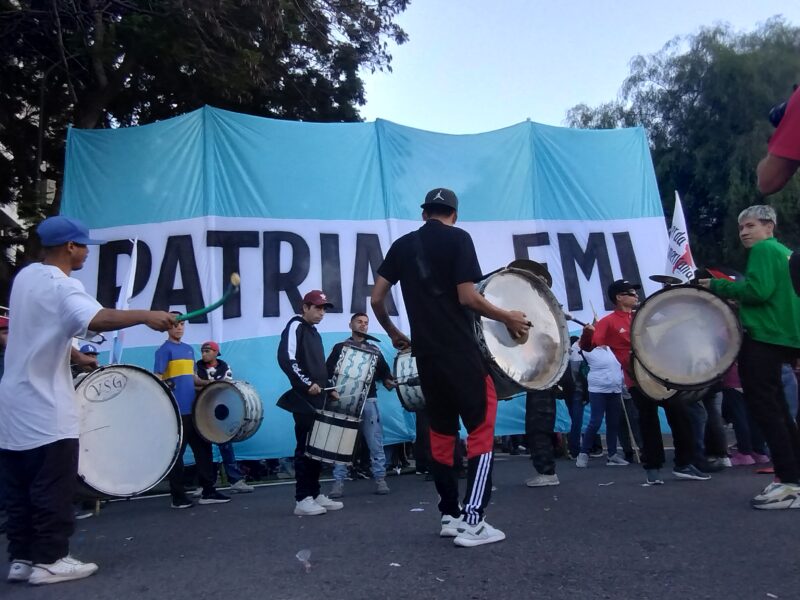
In terms of concrete actions, the repertoire ranges from the microscopic and sustained to the massive and sporadic. What remains constant is the pensioners’ march, held every Wednesday in front of Congress, receiving scant press coverage most weeks, but with a regularity that has lasted for over a year and serves as a weekly barometer of public sentiment. Based on this, targeted strikes are organized; the ATE (Association of State Workers) held a national strike with a march to the Ministry of Economy on August 3rd, and increasingly large-scale mobilizations are prepared weeks in advance: flag-waving demonstrations at the Obelisk, open-air radio broadcasts, petition drives—a whole infrastructure of prior agitation that the organizations call a “week of coordinated action” before the main march on Thursday. On August 6th and 7th, this logic reached its peak, with the march against the private property law followed the next day by the pilgrimage to San Cayetano under the historic slogan “peace, bread, land, shelter, and work.” There is also the looming threat of a general strike, which the three labor unions say they have been building since July, although the actual pace of internal union negotiations suggests that it is still a ways off.
There’s also a shift in the political climate that can’t be explained solely by what’s happening on the streets or at the matches, and it’s related to the World Cup. When the national team beat England in the semifinals and the players posed with the flag that read “The Falklands are Argentine,” the sovereignty debate resurfaced in an unexpected way. Days later, amidst the controversy surrounding the land law, defender Lisandro Martínez posted on his social media, “Argentine lands are not for sale,” and artists who had previously remained politically neutral, such as Tini Stoessel, Emilia Mernes, Lali Espósito, Dillom, and Ca7riel, among others, echoed his sentiments. That same atmosphere was reflected in two other, less institutional but equally eloquent, events: the popular farewell to rock singer Carlos “Indio” Solari brought together neighborhoods in a massive, self-organized mourning event of hundreds of thousands, without any party affiliation; and on the afternoon and evening of August 6, after clashes with police in torrential rain at a protest rally of tens of thousands, just meters from Congress, a group of young people tore down the American flag from the Savoy Hotel on Callao Avenue and burned it on the sidewalk. Neither episode alters the balance of power, but both legitimize the demand for sovereignty among sectors of society that traditional activism has never managed to engage. Meanwhile, on the government side, the season brought its own series of fractures. The fall of Fernando Cerimedo, the digital consultant who was key in the 2023 campaign, now imprisoned in Bolivia accused of instigating an attempted femicide against his ex-partner, exposed the darker side of the troll apparatus that built a good part of the libertarian phenomenon on social media. And the permanent tension between Santiago Caputo and Karina Milei, with the presidential advisor losing ground in the management of the Government’s digital communication, is another symptom of that internal decay. Meanwhile, the emergence of figures presenting themselves as outsiders, such as Daniel Hadad—who is, in reality, a member of the media and business establishment, not an outsider to power—brought together Supreme Court justices and appellate judges, Mauricio Macri arriving early, and Radical and Peronist leaders from Buenos Aires province of different generations, along with officials from opposing administrations, all sharing the same room. This event has given rise to the idea of a centrist space that still lacks a name and leadership, but which is already beginning to unsettle both the ruling party and the opposition itself. And at the heart of this realignment, the tradition of national and popular organizations, forged in resistance to Menem’s neoliberalism in the 1990s, remains alive, albeit with modest numbers. Today, these organizations are once again attracting members, fueled by these new forms of protest, oscillating between internal Peronist politics and a desire for autonomy from that apparatus, a desire they never fully resolved.
The Left Front, in addition to street protests, has chosen the terrain of new territorial organization and has already called for its own demonstration, the “march of anger,” on September 19th. This is an explicit attempt to capture, with little to no representation of the left itself within this current wave of anger, a discontent that currently lacks clear representation and which polls show is migrating toward Bregman rather than Peronism. Peronism, meanwhile, is fighting on two fronts that are not always coordinated with street protests: the legal route, with the Andis case progressing in federal courts, and the strictly electoral route, with its sights set on the long road to 2027.
On the other side of that spectrum is the police operation, which should be described precisely and without exaggerating its scale. On Wednesdays, there are usually barricades, gendarmes, and the occasional pepper spray incident, but this is directed at a truly small protest, nothing comparable to the much more serious crackdowns seen under other governments in the country’s recent history. The August 6th march against foreign ownership was indeed the exception to this pattern, taking place in the rain and cold, with tear gas and rubber bullets fired even at buses and taxis circulating in the area, resulting in more than two hundred injuries. Outside of that specific peak, what the government deploys more frequently is not so much repression in the strict sense, but rather saturation police operations, extremely expensive and designed more to deter through the mere presence of the forces than to actively repress. That cost, in any case, does not stop the Wednesday marches, it sustains them. Each episode becomes material for agitation for the following week, and that is where the logic of the Argentine resistance shows its oldest trait again: the street as a school of organization that police pressure, far from dissolving, ends up hardening.
What remains, viewed as a whole, is a broad but fragmented front, lacking unifying leadership and with at least four political projects vying for control: traditional unionism that negotiates; the organized informal economy that resists on the ground, the left building new organizations out of anger and without representation, and Peronism betting that the judicial and electoral paths can reach where street protests alone cannot. Milei, meanwhile, forges his own alliances with the same pragmatic logic that none of his opponents can quite match: a single objective, reelection in 2027, and everything else—the PRO party, the governors, even the scandals he tries to downplay as mere electoral maneuvers, such as the corruption involving disability assistance funds or the Libra cryptocurrency scam—subordinated to that single calculation.