


By Yıldıran Acar, Political Scientist
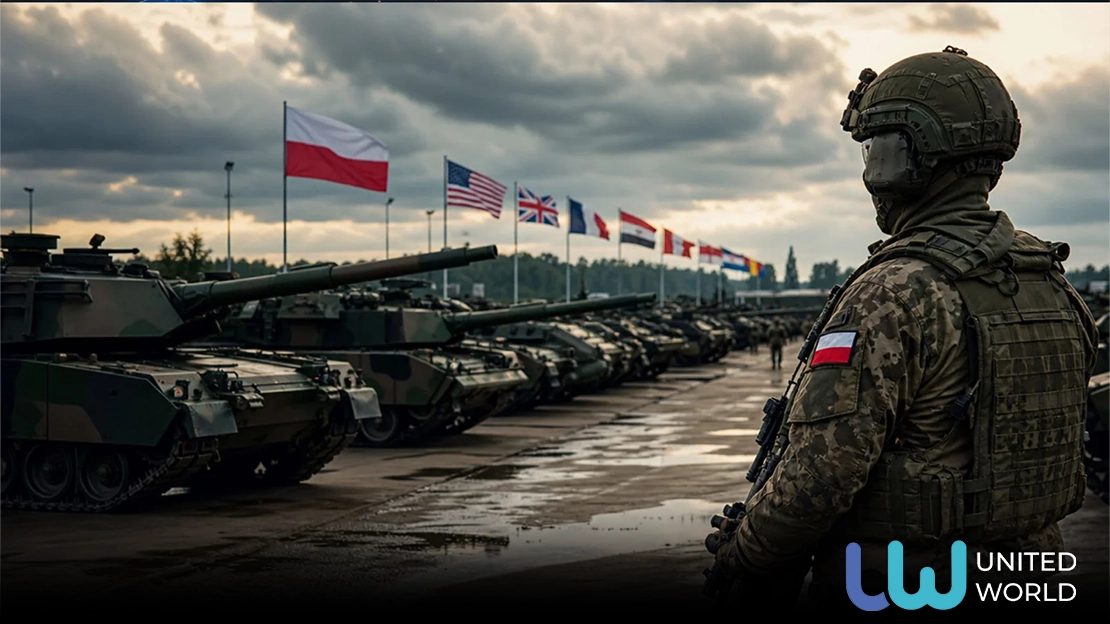
Whilst perceptions of security in Europe have changed significantly in the wake of the Russia–Ukraine War, Poland has emerged as one of the most notable actors in this transformation. Having increased its defense spending to approximately 4.5 per cent of gross domestic product, the Warsaw government is moving towards a more decisive role in the European security architecture through its target of a 500,000-strong armed forces, a comprehensive modernization program and an expanding role on NATO’s eastern flank. This process not only enhances Poland’s defense capabilities but also gives rise to new debates regarding the future of Russia-NATO relations and the balance of security in Europe.
The transformation in Poland’s defense strategy is seen as a consequence of the current geopolitical environment, characterized by a shifting European security architecture and a reshaping of perceptions of regional threats. The Warsaw government views itself as being on NATO’s first line of defense, given that it shares direct borders with Belarus and Russia’s Kaliningrad region. Within this framework, plans are in place to incorporate US-made Abrams tanks, HIMARS multiple rocket launchers and F-35 fighter aircraft, as well as systems such as K2 tanks and K9 howitzers from South Korea into the inventory, whilst priority is also being given to unmanned systems, long-range precision strike capabilities and the development of the domestic defense industry. Polish Defense Minister Władysław Kosiniak-Kamysz’s announcement of the goal to establish one of Europe’s strongest armies by 2030 also sets out the political framework for this long-term defense planning.
Poland’s efforts to enhance its military capabilities also reinforce assessments that the center of gravity in the European security architecture is shifting eastwards. Whilst European security was shaped primarily around the political leadership of Germany and France prior to the Russia–Ukraine War, today Poland, the Baltic States and the Nordic countries are assuming a more visible role in the security of NATO’s eastern flank. Warsaw’s emergence as a logistics hub, the fact that a significant portion of military aid destined for Ukraine is channelled through Poland, and the country’s hosting of NATO deployments on the eastern flank are among the key indicators of this transformation.
The updated defense cooperation agreement signed between Germany and Poland during this process is also noteworthy. The agreement provides for increased military mobility, the protection of critical infrastructure in the Baltic Sea, enhanced coordination in the field of cybersecurity, and the strengthening of logistical capacity on the eastern flank. This cooperation is of strategic importance, particularly in terms of ensuring the security of military aid corridors to Ukraine and making Europe’s defense infrastructure more operationally efficient.
Polish-Ukrainian relations, meanwhile, are expanding beyond military cooperation to encompass the defense industry as well. Cezary Tomczyk, Poland’s Deputy Minister of Defense, described Ukraine as a ‘unique testing ground’ where weapon systems from various countries can be evaluated under real combat conditions, whilst noting that testing certain systems developed in Poland in Ukraine could contribute to the advancement of defense technologies. Whilst this statement suggests that cooperation between the two countries in the defense industry could deepen, it is also viewed as a factor that could heighten regional tensions should it be put into practice.
Moscow, meanwhile, is closely monitoring Poland’s recent military moves. Russian Foreign Ministry Spokesperson Maria Zakharova described the military exercises conducted by Poland near the Russian and Belarusian borders as a “show of force”, whilst arguing that Warsaw is seeking to assume a more active role in Eastern Europe. Viktor Sobolev, a member of the State Duma’s Defense Committee, commented on statements regarding the testing of weapons developed in Poland under wartime conditions in Ukraine, stating that should such a step be taken, Russia would “respond appropriately”. These statements reveal that Russian official authorities are closely monitoring Poland’s increasing military activities from a security perspective.
However, current data does not indicate the existence of a confirmed official policy that Russia has designated Poland as a direct military target. Similarly, the increase in Poland’s military capabilities cannot, in itself, be said to be indicative of an aggressive strategy. The steps taken by both sides on security grounds point to a new era in which the concept of mutual deterrence in Europe is strengthening, and the security dilemma is becoming more pronounced.
Consequently, Poland’s increase in defense spending reflects not only national security policies but also the shifting strategic balances in Europe. The strengthening of military capabilities on NATO’s eastern flank not only increases Poland’s influence in European defense planning but also directly affects Russia’s security calculations along its western borders. The future of Europe’s security architecture will be shaped not only by the course of Russia-NATO relations, but also by how the US’s military engagement in Europe takes shape and the extent to which European countries can develop their collective defense capabilities.