


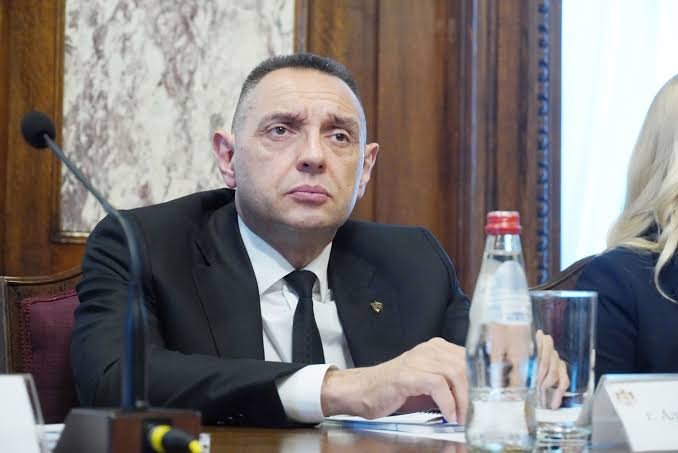
Speech of Bojan Vulin, Chairman of the Committee on International Cooperation of the Serbian Movement of Socialists, at the conference on Global Security and NATO in Istanbul.
Speech of Bojan Vulin, Chairman of the Committee on International Cooperation of the Serbian Movement of Socialists, at the conference on Global Security and NATO in Istanbul.
The World Civilizations Initiative Research Center organized an international conference on Global Security and NATO on June 26-27, 2026, in Istanbul, Türkiye, ahead of the NATO summit scheduled for 7 and 8th of July in Ankara. One of the speakers was Bojan Vulin from Serbia. Vulin is member of the Serbian political party Movement of Socialists and serves as the party’s Chairman of the Committee on International Cooperation. Below we present his speech.
Distinguish Mr. President, Prof. Dr. Semih Koray, and colleagues from the Global Civilizations Initiative Research Center, respected ambassadors, professors, generals and international experts, dear friends from the Republic of Turkey, and especially, highly respected President Doğu Perinçek, from the Vatan Party, which is remembered and respected in Serbia.
Before I begin, I will convey greetings from the president of my parliamentary party Movement of Socialist, Aleksandar Vulin, who could not attend, but is grateful for the invitation. In his view, this gathering is a significant contribution to free thought, especially because it is held in the Balkans a key region and historical strategic crossroads. Such a gathering gains weight at a time when the unipolar world is dead, but the multipolar one has not yet come to life, when we live without international law, without a security system, and without clear spheres of interest. This conference can contribute to the search for answers and the building of a new, more just order.
And now, ladies and gentlemen, allow me to address you:
The modern world is going through deep geopolitical changes. Existing security mechanisms are finding it increasingly difficult to prevent conflicts. The weakening of the unipolar order and the aspirations toward multipolarity increase the danger that relations will be based solely on force.
Lasting stability is not possible without clear rules and mutual deterrence between major powers. When one side judges that the other lacks the will to defend its interests, the risk of crises and local wars grows.
Rising militarization is worrying. The next decade could bring a new phase of global competition. The construction of a new collective security system is necessary – based on dialogue, sovereignty, and common rules.
Without balance and deterrence, the risk of escalation remains high. Particularly dangerous is the disappearance of the nuclear arms control system.
To understand global security, we must look at the Balkans and NATO in the territory of the former Yugoslavia – not as an abstract alliance, but as a force that shapes reality on the ground.
NATO is in Kosovo and Metohija to implement Resolution 1244. But instead of demilitarization, it allows the construction of an illegal Priština army, military bases, arms imports, troop training, and announcements of drone, ammunition, and armored vehicle production.
Serbia cannot afford to ruin its relations with NATO, because it is blackmailed with the lives of its compatriots in Kosovo and Metohija. At any moment, NATO can unleash Priština – to expel Serbs, burn their villages, destroy their churches, without consequences. As in 2004, when in just a few days tens of thousands of Serbs were expelled, monasteries burned, people killed. And today, Priština’s structures continue the pressure – violating agreements, attacking lives and property, making arrests, fabricating charges, staging trials, rigging elections – all to drive Serbs from their centuries-old hearths.
The question remains: does NATO maintain peace or manage instability?
We are witnessing increasing militarization. A trilateral military cooperation is being created between Croatia, Albania, and Pristina’s structures. North Macedonia has signed a strategic partnership with Croatia in defense and security, and Bulgaria has been invited to join. A military ring around Serbia is closing. NATO Secretary General Mark Rutte responded that member states decide individually on their cooperation and that it is not for him to comment.
This does not reflect partnership with Serbia. It reflects the ignoring of our security interests – pressure replacing dialogue.
And when the word dialogue is mentioned – in Serbia we have learned that militarization does not begin with tanks, but when diplomacy stops being dialogue and becomes an ultimatum to choose sides.
That is why we take seriously the ultimatum of German Chancellor Friedrich Merz at the EU-Western Balkans summit on June 5 in Tivat: “Serbia must decide which side it stands on. Balancing between Russia, China, and Europe is not possible.”
Aleksandar Vulin responded: “This is nothing new. Reich Chancellor Hitler asked for nothing different. The answer the Reich Chancellor received, the Federal Chancellor will also receive. Brothers who died for our children are not abandoned because those who killed our children demand it.”
The essence is that Serbia is expected to put geopolitical alignment above its independence. The space for independent policy is rapidly disappearing.
And this is best seen in Bosnia and Herzegovina, where NATO is present in a similar mission as in Kosovo. But Bosnia is not a sovereign state it is run by the Peace Implementation Council, a High Representative not elected by the UN Security Council but by Western countries, and the Constitutional Court includes foreign judges. That is why Serbs in Bosnia see that state only as an administrative framework. The only reason Bosnia is not in NATO is the Republika Srpska, which does not want it – and because of that, not only Serbia but Serbs as a people become a problem.
The statement of Slovenian Minister Sajovic that Zagreb and Ljubljana bear “great responsibility” for peace in Kosovo and Bosnia, although neither Croatia borders Kosovo nor Slovenia borders Bosnia, shows that Serbs are viewed through a security lens – simply because they are Serbs.
But besides the fear of Serbs and the style of governance, what connects NATO in Bosnia and Kosovo is depleted uranium. The poison used in Bosnia in 1995 and in Kosovo in 1999 remains as proof of malignant politics. Its half-life is 4.5 billion years. Tens of thousands of people are dying of cancer.
The paradox: Many want NATO to leave, but its consequences remain for thousands of years. It came to “keep peace,” but with its poison it poisons those it should protect – and all who were there. Over 500 Italian soldiers from the Kosovo mission have also suffered – they seek justice in court and receive compensation from half a million to two million euros. If Italian courts have recognized responsibility, how can NATO have immunity before domestic and international courts? And this is precisely the essence impunity. That is why mechanisms of global security must be restored, along with respect for treaties and UN resolutions. All crises are the consequence of broken agreements.
A new security and governance structure of the world is needed, where there will be no blackmail of the small by the big. Germany blackmails Serbia to end cooperation with Russia and China, while it continues to buy Russian gas and cannot survive without the Chinese market.
Whoever is not afraid of the law thinks they hold justice in their own hands. Slobodan Milošević was the first victim of global militarism. He said: “They are not attacking Serbia because of Milosevic but attacking Milosevic because of Serbia.”
And today, when they threaten us and when they lecture us let us remember those words. Serbia, nor any other free country, is not a problem because of its politicians. The problem is that there are people and nations who refuse to be colonies. And as long as there are such people they will be targeted.
Therefore, when we speak about global security, we must be honest security cannot exist without justice. There is no justice while some decide the fate of others, while UN resolutions are violated, while nations are blackmailed and taught what they are allowed. A world without rules the stronger always wins, but that victory is short-lived. Instability returns, ever more dangerous, and the consequences remain – like depleted uranium, for millennia.