


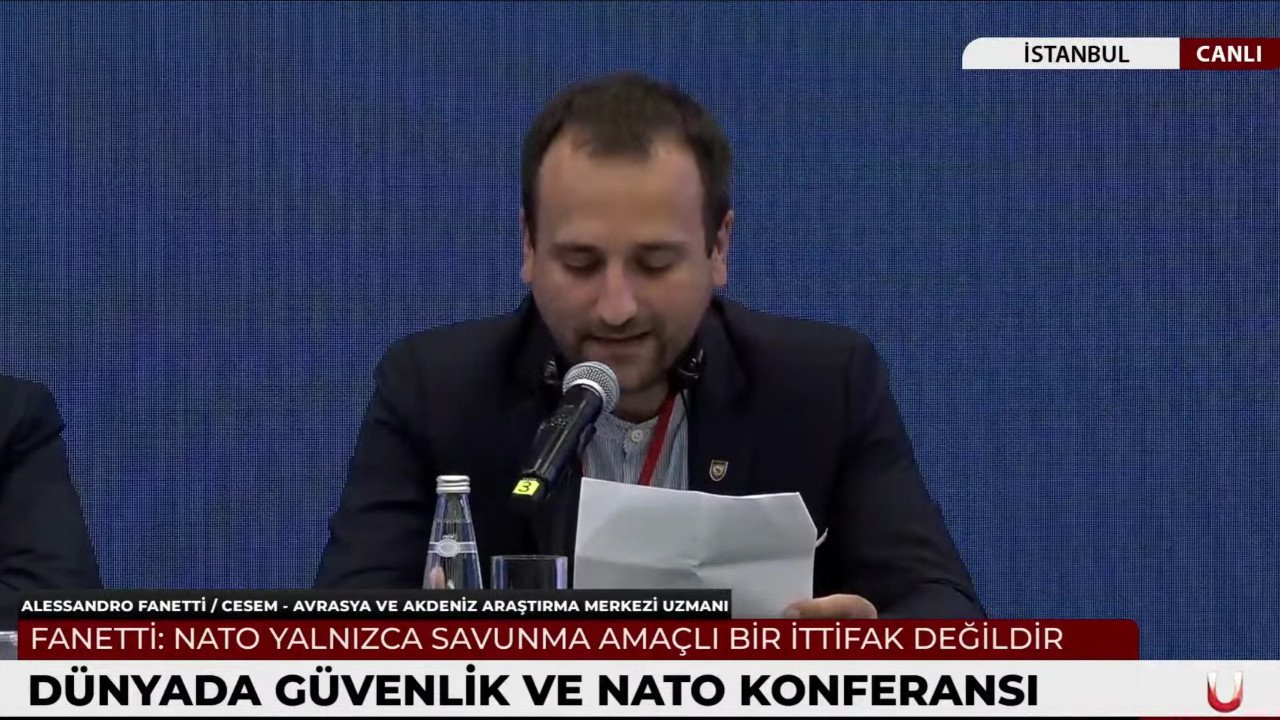
Speech of Alessandro Fanetti, an expert at the Italian Center for Studies on Eurasia and the Mediterranean (CeSEM)
Speech of Alessandro Fanetti, an expert at the Italian Center for Studies on Eurasia and the Mediterranean (CeSEM)
The World Civilizations Initiative Research Center organized an international conference on Global Security and NATO on June 26-27, 2026, in Istanbul, Türkiye, ahead of the NATO summit scheduled for 7 and 8th of July in Ankara. One of the speakers was Alessandro Fanetti from Italy, an expert at the Center for Studies on Eurasia and the Mediterranean (CeSEM). Below we present his speech. The title was set by UWI.
I would first like to thank the organizers, DUNYA-MER and President Semih Koray, of this important conference for creating a space where we can discuss one of the most decisive issues of our age: world security and the future of the international order.
A warm greeting from me and the entire “Eurasia and Mediterranean Studies Centre” (CeSEM).
Ladies and gentlemen,
Humanity’s future cannot be built through confrontation among civilizations, but through dialogue, cooperation, and mutual respect. The study of the interaction among civilizations, the contribution of the emerging Asian powers, and the construction of a Shared Future for Humanity are not merely academic subjects. They are urgent political and moral challenges.
Today, as the NATO Summit approaches, we are called to reflect honestly on the state of world security.
In my view, one of the first questions we must ask is whether NATO can be described simply as a defensive alliance. From my point of view the answer is no.
Its supporters argue that it remains an organization devoted to collective defense. However, the historical record of the last decades suggests a more complex reality.
NATO has participated in major military operations far beyond the territory of its member states. Among the most significant examples are the bombing campaign against the Federal Republic of Yugoslavia in 1999, conducted without authorization from the United Nations Security Council; the intervention in Afghanistan following the attacks of September 11, 2001, which became the longest military engagement in NATO’s history; and the intervention in Libya in 2011, initially justified as a humanitarian mission but whose outcome contributed to instability that continues to affect North Africa and the Mediterranean.
Whether one supports or opposes these interventions, it is difficult to deny that they have shaped the perception of NATO throughout large parts of the world. For many peoples, NATO is no longer seen merely as a defensive alliance, but as an instrument of power projection within a broader geopolitical framework.
This debate is not only international. It also concerns my own country, Italy.
In this contest, many Italians cannot discuss the history of NATO without recalling the shadow of Gladio.
Operation Gladio was a secret stay-behind structure established during the Cold War, officially justified as a contingency network in case of a Soviet invasion. Its existence remained hidden from the public for decades before becoming known (and are we really sure that it itself, or something similar, is not present yet?).
Moreover, the debate surrounding Gladio has gradually evolved beyond the historical events themselves. Some scholars and political observers argue that it raises broader questions about the relationship between intelligence structures, military alliances, economic interests, and democratic institutions. They point to the growing influence of security establishments, defense industries, lobbying networks, think tanks, and strategic policy circles in shaping international affairs.
Whether one accepts these interpretations in full or not, they highlight an important issue for every country: how to ensure transparency, accountability, and civilian oversight when decisions concerning national security and international interventions are made. This question remains highly relevant today, particularly when discussing the future role of military alliances in a rapidly changing world.
After the fall of the Berlin Wall and the dissolution of the Soviet Union, many believed that a new era of peace would emerge.
Fukuyama’s “End of History” thesis aptly summarizes the misconception that many people around the world came to believe.
Instead, a different reality took shape.
The bipolar world disappeared, but a genuinely cooperative international order did not replace it. Rather, the world entered a period often described as unipolar, characterized by the predominance of the United States. And NATO increasingly became one of the principal instruments for maintaining that order.
Unfortunately, this order is too often maintained by the USA, with the support of NATO and its allies around the world, in two main ways:
1) Through the promotion of a strategic “dominance” over the various areas that did not aspire to conform to the unipolar order.
2) And where strategic “dominance” has not been objectively possible, the promotion of “Divide et Impera”.
And all of this has always been carried out through various forms of coercive measures, including military ones.
In this contest, many critics argued that the post-Cold War era also witnessed the growing influence of what some have called the military-industrial and security establishment: the network of institutions, defense contractors, strategic research centers, and policy actors involved in defining long-term security priorities. Regardless of the terminology one prefers, the influence of these structures has become an important subject of public debate in many countries.
For a time, this structure appeared unchallenged.
Yet history never stands still and step by step new powers emerged, new economic centers developed, and new political realities took shape.
Countries such as China and Russia (just to say the biggest players, but with so many others “next to them”, at least in the vision of the need for a new global geopolitical order) began promoting alternative visions of international relations and advocating a multipolar world. And other states also sought greater strategic autonomy and independence in global affairs.
Whether one agrees with all their policies or not, the rise of multipolarity reflects a broader historical process: more nations are demanding a greater voice in shaping the future of humanity.
In this regard, how can we fail to point out the existence of international organizations that have had significant “momentum” in recent years such as, for example, the BRICS+, the Shanghai Cooperation Organization and the Alliance of Sahel States.
Examples of resistance on the one hand and the promotion of another “geopolitical world” on the other.
In this context, the role of Iran, despite decades of sanctions and pressure, remains significant. The country continues to resist external attempts to dictate its political trajectory and has become an important actor in regional dynamics.
Likewise, Cuba continues to represent something much larger than its geographical size.
In fact, in the political imagination of Latin America (and beyond), Cuba is not simply a country. It is a symbol of sovereignty, self-determination, and resistance to external pressure.
Any threat directed against Cuba is therefore perceived by many throughout the continent and beyond not merely as a dispute involving one island, but as a challenge to the principle that peoples have the right to determine their own destiny free from coercion.
Like David facing Goliath, it has sought to preserve its independence despite extraordinary difficulties.
So, Cuba has been showing us all since 1959 that another world is possible.
All of this irrespective of whatever may happen.
In this contest, Cuba has also played an important role in efforts to strengthen Latin American integration through initiatives such as the Community of Latin American and Caribbean States (CELAC) and ALBA-TCP, both of which reflect aspirations for greater regional cooperation and autonomy (and therefore to make this area one of the poles of the new multipolar world).
I firmly believe that the transition from a unipolar to a multipolar world is a complex process, one that will inevitably involve both setbacks and progress. Yet one fact remains clear: this transformation is unstoppable and irreversible, short of a global conflict aimed at halting its final emergence.
I would also like to say a few words about the country hosting this important initiative: Türkiye.
Türkiye occupies a unique position in contemporary geopolitics and, as I had the opportunity to point out last year again here in Türkiye at “The Eastern Mediterranean – Black Sea Conference”, West Asia (and Asia as a Continent) and its most proactive, Eurasian and multipolar forces have all the cards to play a leading role in the transition to the “new world”. It is clear and straightforward that Türkiye can and must play a pivot role. A Türkiye fully inserted in the “multipolar dynamic”, that is, able to play all its cards without external ties and laces of any kind. Indeed, there are few “States – Civilizations” in the world that can aspire to the leading role within the geopolitical pole of reference and in the global landscape. And Ankara is one of those, first and foremost because of its history and the capabilities it can still bring to bear. In the service of itself, of its pole of reference and of a fairer and safer world for all.
Today, Türkiye is a NATO member, yet it has repeatedly demonstrated a certain independent approach to international affairs. It has maintained dialogue with actors who often find themselves on opposite sides of global disputes. It has sought to defend its own national interests while navigating an increasingly complex regional environment.
This strategic autonomy may become even more important in the years ahead.
And the recent statements by Israeli Diaspora Affairs Minister Amichai Chikli, who stated that “Syria and Türkiye pose a greater threat to Israel than Iran”, demonstrate once again what stage we are at.
At a time when the Middle East faces immense tensions, what the region needs is not new wars, but dialogue, diplomacy, and security arrangements based on mutual respect and sovereignty.
The peoples of the region have suffered enough from conflicts.
What is required now is a framework capable of guaranteeing stability without domination and cooperation without coercion.
Ultimately, the central question before us is simple.
Can humanity continue relying on systems built around rivalry, military blocs, sanctions, and geopolitical confrontation?
Or is it time to move toward a genuinely multipolar order based on sovereign equality, peaceful coexistence, dialogue among civilizations, and shared development?
I believe the answer is clear.
World security cannot be built through hegemony and it cannot be built through permanent confrontation. It cannot be built through the belief that one nation, one alliance, or one bloc possesses the right to determine the future of all others.
A stable international order requires balance and respect, recognition that humanity’s diversity is a strength rather than a threat.
The future must belong not to domination, but to cooperation.
Not to unipolarity, but to dialogue among multiple centers of civilization. Not to endless conflict, but to a shared future for humanity.
As my compatriot, the great communist intellectual Antonio Gramsci, pointed out decades ago:
“The old world is dying; the new one is slow to appear. And in this contrast between light and dark monsters are born.”
It is the responsibility of all of us to ensure that monsters do not prevail, and that a future of peace and stability prevails instead.
Thank you very much.