


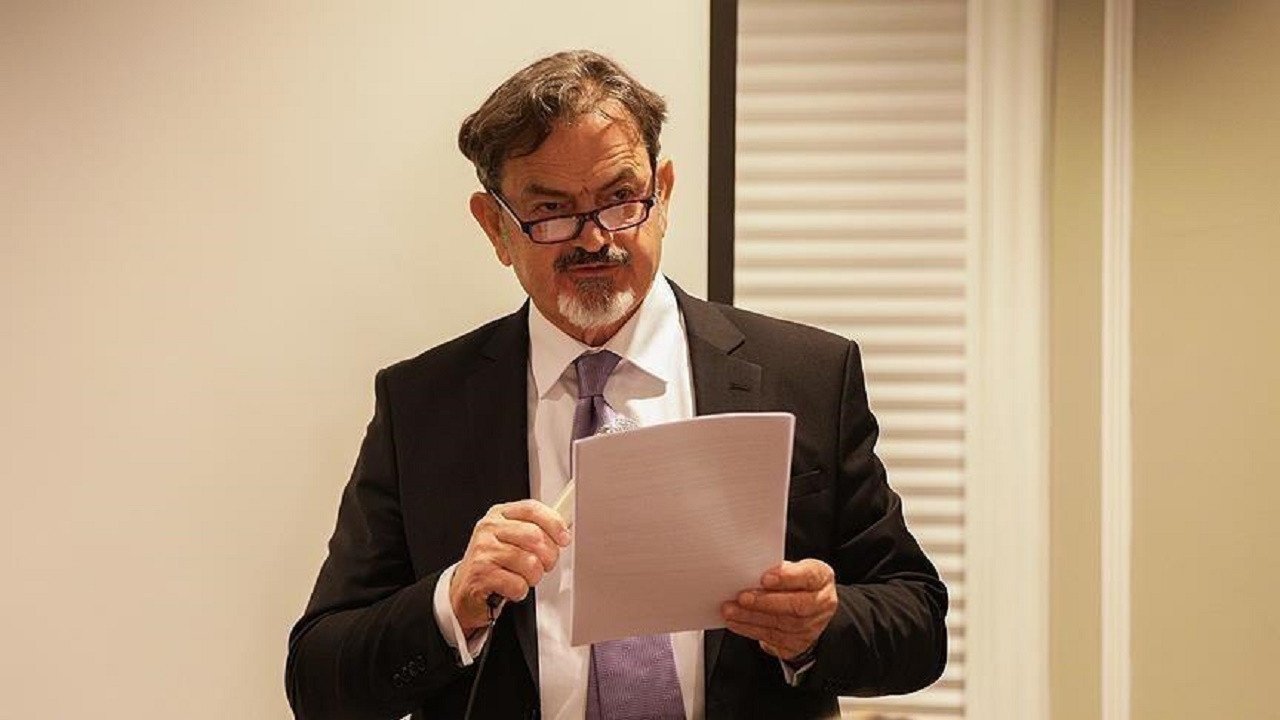
Interview with retired Rear Admiral Dr Deniz Kutluk, from the Turkish Naval Forces.
Interview with retired Rear Admiral Dr Deniz Kutluk, from the Turkish Naval Forces.
Emrah Zorba, Editor-in-Chief of the journal Teori from Türkiye, interviewed Retired Rear Admiral Dr Deniz Kutluk about the NATO Summit on 7–8 July. We are sharing the interview published in the journal’s July 2026 issue, with our readers. Translated into English by UWI.
Türkiye is hosting NATO Summit on 7–8 July in Ankara.
We spoke with retired Rear Admiral Dr. Deniz Kutluk, who served in NATO for many years, about the future of the Alliance in the new multipolar world order, the economic and military cracks in the transatlantic relations, the 20-trillion-dollar defense industry competition between Europe and the US, and Türkiye’s geopolitical course and military strategy ahead of NATO’s critical Ankara summit.
“NATO will do damage control”
US Secretary of State Marco Rubio questioned NATO’s purpose over allies not opening their bases for the Iran operations. In your view, has this completely ended the Aliance’s former strength and partnership structure?
No. I think it showed Marco Rubio’s ignorance. Because it showed that Rubio doesn’t know that these military bases can only be made available in line with NATO’s common purposes. We should put this down to his inexperience. It shows that his advisory team, or the elements within his close headquarters staff, either didn’t work properly or they simply didn’t exist.
NATO bases can be used within the scope of Article 5 of NATO. First and foremost, there must be a threat concerning the territorial integrity of member states. And that threat must be identified beforehand, not suddenly. At this stage, that threat was defined as Russia at the Madrid Summit four years ago, and NATO is working out on the structuring of forces and war plans accordingly. But how realistic that was is, of course, a separate matter for debate.
Does the fact that European countries are disturbed by US demands and want to establish their own security mechanisms create an irreversible rupture in the transatlantic bond?
Things are moving in that direction. It appears to have created such a rupture. There are signs that the summit to be held in Türkiye will be a damage control summit. There are especially strong indications that Canada will separate itself from the US and take part in Europe’s defense. These signs will continue to grow. But the NATO Secretary General is also using the roughly 8,000 bureaucrats under his command to keep NATO together, and probably he will try to do “some things” in the Summit.
Türkiye’s geopolitical position
In new security reports in the West, the UK, Norway and Ukraine are listed as strategic partners, while Türkiye is left completely outside new military architecture. How should we read this?
These three countries can form no strategic structure.
As for Ukraine, in my view, Ukraine has been stripped to the bone. Let alone providing defense support to other countries, it no longer has the means to defend itself. It continues to lose territory while suffering 1,300 to 1,400 casualties a day. My view is that by then Russia will have transformed Ukraine into a neutral state in line with its own political objectives.
Türkiye must continue taking the right steps toward becoming self-sufficient in defense.
At a time when the international order is splitting into blocs, as it did before the First World War, can Türkiye position itself within a fully “Europeanized” NATO structure?
This is, of course, a double-edged sword. If Türkiye is the demanding side, what Türkiye obtains will be smaller. If the European Union is the side making demands of Türkiye, a more balanced structure can emerge.
But Türkiye’s issue is how it will provide for its own nuclear defense. I can’t provide this within the EU. There is only France saying, “I can provide nuclear defense”, but its capabilities are not sufficient. So, Türkiye must either secure nuclear defense or establish its own nuclear capacity.
Türkiye should approach the EU by negotiating its demands. The fact that a European think tank such as the European Council on Foreign Relations has proposed a European security architecture that excludes Türkiye is, frankly, not something so alarming.
The question before the “new security architecture” of Europe
But the question before such a security architecture is whether Russia is a threat to Europe or not? If Russia is supposed to be a threat, what kind of threat is this, when it has not even been able to obtain 22 percent of Ukraine’s territory with its military power in four years? In that case, with these capabilities, Russia is not really a threat. Does Russia, then, have an expansionist ideology? Does it have such a political objective? The Soviet Union had but Russia doesn’t. Does Russia have a shortage of territory that would lead it to expand? It doesn’t. Does Russia need Europe’s natural resources? No, it doesn’t. Russia already possesses vast, largely untapped natural wealth, with reserves valued at well over 100 trillion dollars. It is not yet able to fully process these resources because it lacks sufficient labor power, technology and capital. Russia is seeking cooperation with Europe and the US to process them.
At the same time, the US itself is pursuing cooperation with Russia whether on limiting nuclear weapons, on the development of industrial resources and rare earth elements, or on the future management of Arctic resources. So if Russia and the US are cooperating, why is Europe, on its own, treating Russia as a threat? Here we can see the traces of how, during the Biden administration, NATO misled the Europeans.
When we look at the Eurasian continent, we see that Europe and Russia are part of a single geopolitical whole. We also see that Europe and Russia are natural partners bound to move toward cooperation. If Nord Stream I had not been shut down, and if Nord Stream II had not been blown up, Europe would today be producing with much cheaper energy inputs, at roughly half of its current costs. Living costs would not have risen so sharply; inflation, and even stagflation, would not have reached this level. All of this is the result of the US’ nearly 17-18 years of groundwork aimed at turning Europe and Russia into enemies.
Türkiye and Europe diverge on Russia
Now let’s come to Türkiye’s place in these circumstances. Türkiye cooperates with Russia in seven-eight different fields, and with Ukraine in five-six fields. Therefore, Türkiye must not become a party to the Russia-Ukraine confrontation. Our interests demand this.
We have interest-based cooperation with Russia across a wide range of areas: from Turkish construction companies in Moscow to companies exporting fresh fruit and vegetables; from the relations in Black Sea security to our dependence on Russia in natural gas and nuclear energy; from the long-term cooperation we may conduct with Russia as a permanent member of the UN Security Council to the fact that Russian tourists choose the Antalya region as a holiday destination. Now, simply because the Europeans have decided to arm themselves, to do their defense spendings on their own industries, and to use part of their tax revenues for development through the defense industry, and simply because Biden encouraged them to do so, should Türkiye follow the same path? I don’t think so.
Therefore, there is a fundamental divergence between Türkiye and Europe when it comes to security cooperation. And both sides read this divergence in the same way. The Europeans say: “You don’t see Russia as a threat in your security paradigm. We do. So how can we have security cooperation?” And we say: “We are a nation that fought Russia 13 or 14 times in history. So we know how to deal with Russia. You should learn that too, develop your areas of cooperation.” If being part of a security organization necessarily means defining a country as a threat, then we think differently on that point. Then Türkiye’s and Europe’s paths are different.
This leaves Türkiye with two options: either stand on its own feet (as far as we could secure our own nuclear defense) or cooperate with others capable of providing a nuclear umbrella. From this point onward, the issue must be discussed with the raison d’état.
“Türkiye does not want to be dependent on either side”
What do you think about the future of the Atlantic alliance and NATO?
NATO is going through a very difficult, painful downward slide, and the NATO organization is trying to slow that process down. By “the organization,” I mean the international political and military headquarters structure in Brussels.
The US isn’t worried about this. In fact, the US is content to let NATO to its downward slide. This is where the biggest American-European divergence emerges.
Partly under US pressure, European countries increased their defense spending. But until now, around 70 percent of that spending was going to American defense companies through procurement contracts. In other words, money was flowing from Europe into the US economy. Now Europe says: “From now on, we will do this ourselves. We will award these contracts to our own defense companies.” This will mean a serious economic loss for the US.
That is why, for example, the NATO Secretary General held a meeting with the Americans this week, on June 10. Only with the Americans. The meeting was called “The Transatlantic Defense Industry Access Forum.” So, this is a broad industrial cooperation meeting, and I believe it is a first. Around 50 American companies attended, along with the Belgians. The American defense industry is taking a position against the line of American politicians who say, “We will leave NATO”. In other words, the extremely powerful American military-industrial complex, coined by Eisenhower, is moving to prevent NATO from slipping out of its hands. What I am saying is that American defense industrialists are worried that Europe and its defense companies are building an independent structure. They want to control this process.
So, first of all, there is a huge defense economy pie on the table. To give you a sense of its scale: last year there was a decision to raise defense spending to 5 percent. Of this, 3.5 percent is called “core defense investment”. The remaining 1.5 percent is for the domestic infrastructure that supports defense: roads, railways, ports and so on. Now, a 1 percent increase in European defense spending corresponds to 6 trillion dollars in defense expenditure. If this spending rises to the actually accepted level of 3.5 percent of GDP, then the total size of this transfer reaches around 20 trillion dollars.
When we look at Türkiye, we see something different. Türkiye is already taking its own steps in this field. Türkiye does not want to be dependent on either side, neither Europe nor the US. Since 1975, we have been subjected to embargoes that disrupted our defense for the most trivial reasons. From 1964 onward, we began these efforts with the “The Nation Will Build It” campaigns. In 1980, for the first time, we bought our own aircraft with our own money; for the first time, we bought our own ship with our own money. Then we developed them through reverse engineering. Today, we have reached the point where we can produce many of our own defense capabilities. With the KAAN fighter jet, we will enter the highest stage of this process.
Türkiye is also diverging from Europe and the US in defense industry production, modeling, costs and procurement. Türkiye says: “These resources are mine, and they must remain with me. The money I need to spend on defense should not flow abroad. I will develop my own industry and sell to others.”
This year, Türkiye’s defense exports have reached 12 billion dollars. That is a truly remarkable achievement, reached in a very short period, in four or five years. It is something to be proud of. Türkiye is now aiming to maximize this success.