


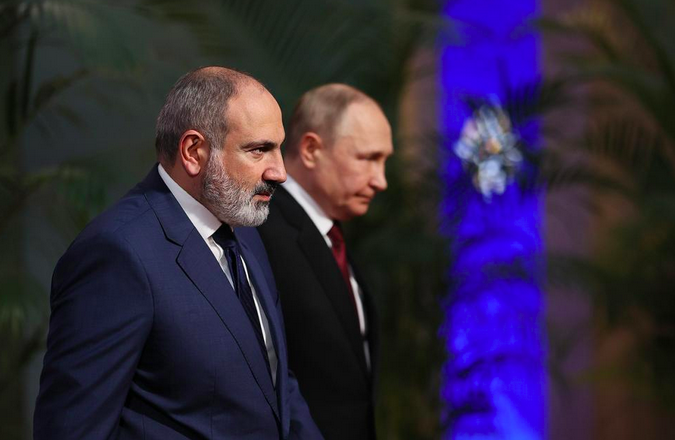
Speaking to Uwidata.com, Aslan Rubayev, Director of Russia’s Eurasian Problems Monitoring Center, and Armenian political analyst Artur Aghajanyan shared their assessments.
Speaking to Uwidata.com, Aslan Rubayev, Director of Russia’s Eurasian Problems Monitoring Center, and Armenian political analyst Artur Aghajanyan shared their assessments.
By Tehran Tapdigov, from Baku / Azerbaijan
On June 7, Armenia held its latest snap parliamentary elections. Prime Minister Nikol Pashinyan’s ruling Civil Contract Party secured 49.75% of the vote, winning 64 seats in parliament and gaining the right to form a government on its own.
Former President Robert Kocharyan’s “Armenia” Alliance won 12 seats (9.92%), while the “Strong Armenia” Alliance, associated with businessman Samvel Karapetyan, secured 29 seats (23.27%), earning representation in parliament.
What lies ahead for Armenia? In particular, what can be expected from Pashinyan’s government as relations with Russia continue to deteriorate?
Speaking to Uwidata.com, Aslan Rubayev, Director of Russia’s Eurasian Problems Monitoring Center, and Armenian political analyst Artur Aghajanyan shared their assessments.
According to Rubayev, Pashinyan’s return to power indicates the continuation of an anti-Russian political regime in Armenia.
“Therefore, it is essential for a strong pro-Armenian position to emerge within Armenia itself, one that would prevent a shift from Russia toward the West. Such a shift does not serve Armenia’s own national interests. Severing ties with Russia would have serious consequences for Armenia. It must be said that Russian-Armenian relations are currently experiencing their deepest crisis, and unfortunately, this deterioration is occurring on a reciprocal basis from both sides.”
Rubayev argues that Russia has also made a number of questionable decisions toward Armenia, which finds itself confused amid a difficult geopolitical environment.
“In this regard, Russia appears to be taking an insufficiently mature approach to resolving these issues, despite understanding Armenia’s growing orientation toward the West. In recent years, Russia has failed in its soft power strategy, public diplomacy efforts, and attempts to create a pro-Russian information space within Armenia. As a result, the political arena has been filled by Russia’s opponents — both the collective West and many other countries seeking to benefit from the situation.”
Rubayev added that he expects Russian-Armenian relations to cool even further, as Armenia has already declared its intention to diversify its trade, political, and security partnerships away from Russia and toward Europe.
“Europe appears ready to replace Russia in many areas, and naturally, this is not in Russia’s interest. However, I understand that a certain geopolitical struggle for the South Caucasus is currently underway. It is entirely possible that European actors want to turn Armenia into a showcase project within the post-Soviet space. This would mean further pushing Russia out of the South Caucasus and creating another anti-Russian stronghold.”
Armenian political analyst Artur Aghajanyan believes that Pashinyan still has several years ahead of him in power.
“A great deal can change. Of course, much will depend on Armenia’s political and economic situation. In the previous parliamentary elections, Pashinyan’s Civil Contract Party held 71 seats. This time, it has secured fewer mandates. As a result, he can no longer independently initiate a referendum. He will need to convince members of other parliamentary factions and opposition parties in order to gather sufficient support. Naturally, achieving a majority on various issues will be more difficult for him this time.”
Aghajanyan also noted that Armenia could face economic difficulties as its ties with Russia continue to weaken.
“As for whether Armenian-Russian relations will change, they already are changing. The supply of agricultural products, fruits, vegetables, mineral water, and other goods has been halted. Does Armenia need alternatives? I have always argued that Armenia should seek alternatives in other countries if it truly intends to leave the Eurasian Economic Union and pursue membership in the European Union. However, this process is far from quick.
We know several countries that have been waiting for years, even decades, to join the EU. Therefore, it is important to remain realistic and view the situation objectively.”
The analyst stressed that Pashinyan understands these realities and is not rushing to withdraw from the Eurasian Economic Union.
“Certainly, there is pressure associated with having to choose between competing geopolitical options. Nevertheless, Armenia needs alternatives and must explore additional markets. This could include gas supplies from Azerbaijan, Turkmenistan, or Kazakhstan. I also believe that if a peace agreement is reached between the United States and Iran, Armenia could potentially import significant volumes of gas from Iran. This could help compensate for possible losses if relations with Russia continue to deteriorate.”
Aghajanyan further emphasized the importance of opening the Zangezur Corridor (the TRIPP route) during Pashinyan’s tenure.
“The route commonly referred to as the Zangezur Corridor could contribute significantly to these objectives. Azerbaijan, Armenia, and Türkiye all have an interest in its development. It would bring investment into the Armenian economy and should be actively pursued. At the same time, Armenia’s trade relations with Russia will remain important. Much will also depend on the position of the opposition, which remains a significant political force. Therefore, a cautious and pragmatic approach is necessary when dealing with all of these issues.”